
Dr Ameera AlHasan
Opportunities, functions and three wise monkeys
Originally designed to mimic human intelligence, it now seems clear that artificial intelligence (AI) can surpass human performance in many domains. In surgery, the practical application of AI is still very limited. However, the technology is advancing at an exponential pace, and it is only a matter of time before it is adopted into routine use both at the bedside and in the operating theatre.
In order to realize where AI will be most useful in surgery, opportunities for its application must be identified. An opportunity is where there is a problem or a difficulty that AI can help solve. Such opportunities are dictated by either the situation at hand or the innately human limitations of the surgeon (Figure 1). Situations that pose challenges are those that harbour uncertainty, tedium or risky outcomes at their core. These include clinical decision-making, prediction modelling1, documenting and searching electronic health records, and performing challenging tasks such as constructing a standard airtight anastamosis. Surgeons are human beings whose performance is subject to anatomical and physiological limitations, such as limited sensory perception (vision), motor function (reach, precision, or speed), and fatigue. AI driven automata, such as surgical robotics, are designed with the objective of overcoming some of these limitations. Where a situation is most challenging and the abilities of the surgeon are most limited is the exact point where AI should provide maximum benefit.
Figure 1 Factors that create opportunities for the application of artificial intelligence (AI) in surgery
In addition to opportunities, potential applications also depend on the functions of AI itself. AI is designed by entering massive quantities of data into predefined algorithms, which learn to make predictions and perform tasks through machine learning. These algorithms can mimic the circuitry in the human brain through their own neural networks. AI processes visual data through computer vision, and human language through natural language processing (NLP). This article uses the latter two functions to explore the potential applications of AI in surgery, and adopts the ancient image of the three wise monkeys who “see no evil, hear no evil, and speak no evil”, in the hope that AI can do the same and hence be used wisely to benefit surgeons and their patients.
See no evil
Nowadays, it seems insufficient to rely on the bare human eye when performing complex surgery. This has led to a myriad of advances in anatomical and physiological imaging such as advanced laparoscopic and robotic optical systems, on-table angiograms, and the use of indocyanine green (ICG). It is presumed that the more a surgeon can see, the better they can perform their surgery and thus avoid potential complications.
AI can also “see” and process images through what is known as computer vision. The AI algorithm is fed many surgical images and videos, which it “sees” by breaking them down into their basic components (e.g. pixels), understands what it sees through convolutional neural networks (CNN) like a human brain’s visual cortex, and remembers what it is sees through long short-term memory (LSTM) like human memory2. AI is being trained through computer vision to recognize anatomical landmarks, key steps and surgical instruments in various surgical procedures3. In research, this has been done for laparoscopic cholecystectomy3, laparoscopic sleeve gastrectomy4 and other surgical procedures in ophthalmology and gynaecology2.
A potential application currently on the horizon is in surgical education where AI, once trained to recognize correct surgical procedures, can act as a digital mentor2 for surgeons-in-training. It should be able to both teach and assess surgeons, initially in a simulated setting, and later in the operating room on real patients where it would help alert surgeons intraoperatively to avoid inadvertent organ injury for example. AI is expected to do so more accurately once combined with on-table imaging (angiograms, fluoroscopy or ICG). Once achieved, this will be groundbreaking in standardizing both surgical training and surgical care. One can only imagine the difference it would make in areas of the globe where there are few surgeons and even fewer surgical mentors. There are currently several major limitations to achieving this goal, mainly the lack of a massive number of filtered and standardized surgical videos1 that are required as data to feed AI algorithms. Additionally, there are tremendous variations in anatomy, pathology, and surgeon performance that AI will have to be trained to recognize.
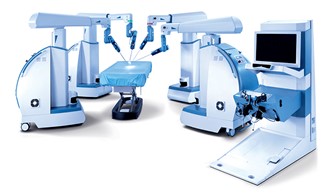
The ultimate goal is for AI driven surgical robots to operate autonomously5. In contrast to human evolution, the development of AI with fine motor skills is technically more challenging than that of AI with advanced mental faculties1. Furthermore, issues of acceptance and accountability must also be addressed1,6. Professionals and patients must first accept the reality of these autonomous machines, and issues of accountability and litigation in cases of errors and complications must be defined well ahead of deployment6. However, to start with, robots can be used to complete certain operative steps on their own, such as suturing or stapling, instead of entire surgical operations1. Powered by computer vision, the smart tissue anastomosis robot (STAR) has already outperformed surgeons on suturing tasks on multiple platforms including the da Vinci robotic platform and laparoscopy7.
Hear no evil and speak no evil
AI processes written and spoken human language through NLP. This has multiple uses in surgical documentation, such as using speech recognition to help record and transcribe operative notes1.
NLP-powered AI can be used to tackle the tedious task of searching, summarizing and interpreting thousands of electronic health records. In the hospital setting, this provides a fast and cost-effective method of extracting and generating data for performance audits, billing records8, and clinical outcomes including postoperative complications (e.g. anastamotic leak, re-hospitalization, mortality rates etc.). These data are invaluable in constructing clinical and surgical risk prediction models and calculation tools, which will guide clinicians in predicting outcomes and counseling patients before surgery. It is hoped that this will ultimately improve patient care1,9.
AI can use NLP and machine learning to sift through and interpret information from electronic health records, clinical reports and the surgical literature to generate data for research purposes10. In the future, researchers will have instant access to massive quantities of data through AI. However, this is fraught with challenges, one being the variability in health record quality with the use of unrecognizable abbreviations, language errors and careless documentation techniques, all of which AI may be unfamiliar with and thus unable to process.
Finally, it is worth mentioning ChatGPT, an AI powered chatbot developed by OpenAI, which has been both innovative and disruptive in the surgical literature. It uses NLP to conduct extensive Internet searches, extract and summarize information, and can independently compose meaningful written texts when asked to do so by users. Researchers have officially used and cited ChatGPT as a coauthor on their publications11. Heated discussions are currently taking place on the advantages and perils of using ChatGPT to author, review and even edit surgical research.
Conclusion
AI is a powerful tool with many potential applications in surgery. These applications depend on opportunities where situations are challenging or surgeons’ abilities are limited. They also depend on AI’s intrinsic abilities and functions. Two important such functions are computer vision and natural language processing. The former can be used to develop AI that can recognize, teach and even perform specific operative procedures. The latter, on the other hand, is used to extract data for clinical decision-making, outcome measurement, and research purposes. AI, when used wisely can indeed “see no evil, hear no evil, and speak no evil”, but rather can help surgeons improve practical and academic performance. Of course, challenges and dangers exist but these lie outside the scope of this article.
References
Hashimoto DA, Rosman G, Meireles O. Artificial Intelligence in Surgery: Understanding The Role Of AI in Surgical Practice. New York, NY: McGraw Hill: 2021
Ward TM, Mascagni P, Ban Y, Rosman G, et al. Computer vision in surgery. Surgery. 2021; 169(5); 1253-1256
Twinanda AP, Shehata S, Mutter D, Marescaux J, et al. EndoNet: A deep architecture for ecognition tasks on laparoscopic videos. IEEE Transactions on Medical Imaging. 2016; 36(1):86-97
Hashimoto DA, Rosman G, Witkowski ER, Stafford C, et al. Computer Vision: Analysis of Intraoperative Video: Automated Recognition of Operative Steps in Laparoscopic Sleeve Gastrectomy. Annals of Surgery. 2019; 270(3): 414-421
Panesar S, Cagle Y, Chander D, Morey J, et al. Artificial intelligence and the Future of Surgical Robotics. Annals of Surgery. 2019; 270(2): 223-226
AlHasan A. Ethical concerns grow as AI takes on greater decision-making role. ACS Bulletin. 2023; 108(2): 34-37
Leonard S, Wu KL, Kim Y, Krieger A, et al. Smart tissue anastomosis robot (STAR): a vision-guided robotics system for laparoscopic suturing. IEEE Trans Biomed Eng. 2014; 61(4): 1305-1317
Mellia JA, Basta MN, Toyoda Y, Othman S, et al. Natural Language Processing in Surgery: A Systematic Review and Meta-analysis. Annals of Surgery. 2021; 273(5):900-908
Balch J, Upchurch Jr. GR, Bihorac CA, Loftus T. Bridging the artificial intelligence valley of death in surgical decision-making. Surgery. 2021; 169(4): 746-748
Wyatt JM, Booth GJ, Goldman AH. Natural Language Processing and Its Use in Orthopaedic Research. Current Reviews in Musculoskeletal Medicine. 2021;14:392-396
Janssen BV, Kazemier G, Besselink MG. The use od ChatGPT and other large language models in surgical science. BJS Open. 2023;7(2):zrad032


.png)





.jpg)

