
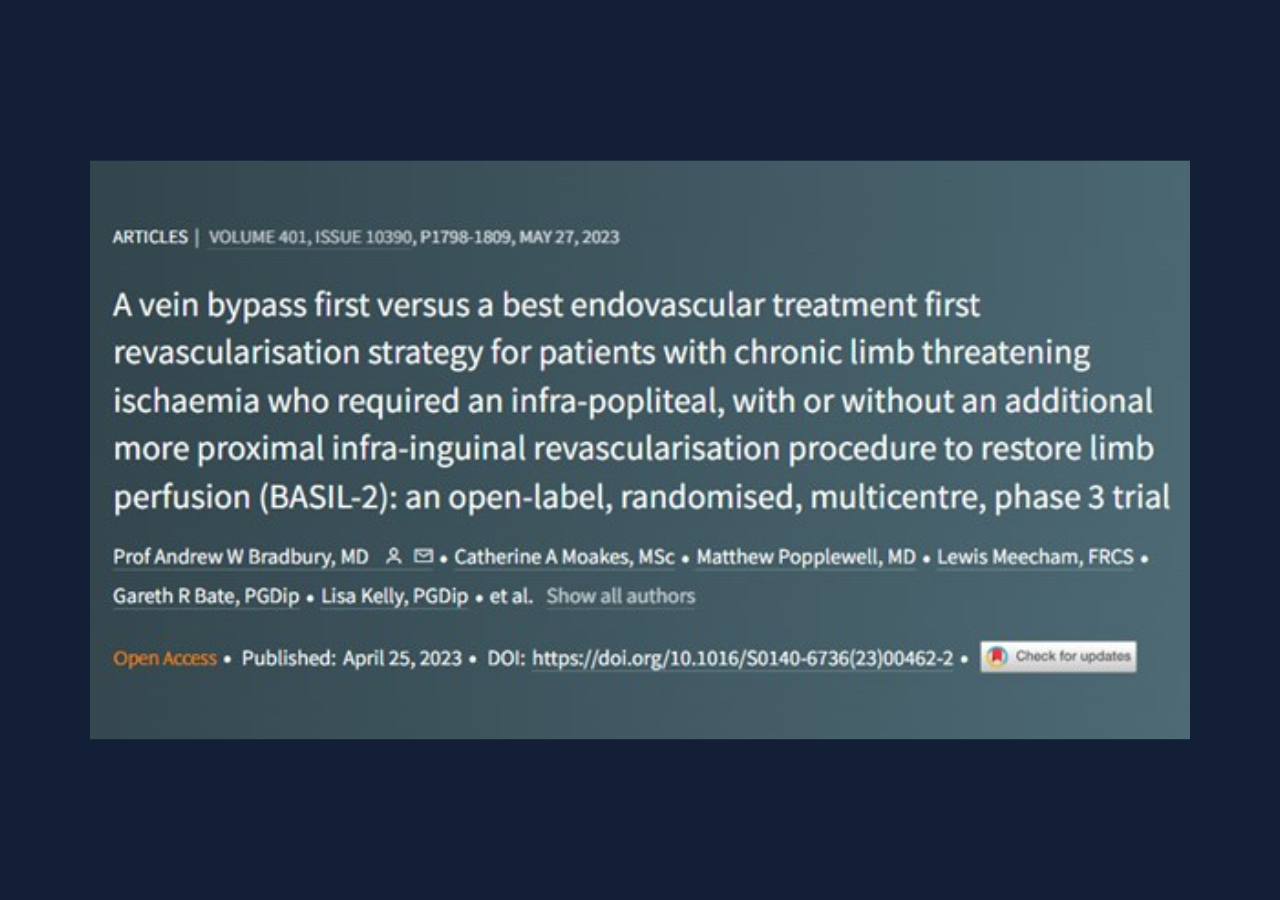
I have been asked to offer some thoughts on what the BASIL-2 trial may mean following publication of the headline results in the Lancet on 25 April 2023.
The journey to BASIL-2 started around 25 years ago when I was a Senior Lecturer in Vascular Surgery at Edinburgh University, Scotland, and was fortunate enough to be awarded an NIHR HTA grant for the first BASIL, now known as the BASIL-1, trial. In the late 1990’s, the idea that one could treat chronic limb-threatening ischaemia (CLTI), in those days called CLI or SIL (critical limb ischaemia or severe ischaemia of the leg), other than by means of bypass using either vein or prosthetic conduit was considered extremely controversial. There were real concerns that the endovascular management of CLTI was being adopted in the absence of good evidence that it was a clinically and cost effective treatment option. And that is why NIHR HTA put out a call for an RCT in this area of practice.
We ran BASIL-1, first in Scotland, and then when I moved to Birmingham in 2000, across most of the UK between 1999 and 2004. In BASIL-1, a bypass first and a plain balloon angioplasty first revascularisation strategy resulted in similar amputation free survival out to 2 years. However, in patients who survived for two years, randomisation to bypass first was associated with significant improvement in overall survival and a trend towards improved amputation free survival. About 25% of the bypasses were prosthetic, which reflected practice at that time. Around 75% of the patients in BASIL-1 had a revascularisation that was limited to the femoro-popliteal segment. A post-hoc, sub-group analysis of approximately 100 BASIL-1 patients that had an infra-popliteal, with or without a femoro-popliteal, revascularisation also showed a trend in favour of (vein) bypass surgery.
Following the publication of BASIL-1 in the Lancet (2005), and then in a dedicated supplement of the JVS (2010), I was invited by the UK National Institute of Health and Care Excellence (known as NICE) to join an expert working group that was developing UK National guidelines on peripheral arterial disease (PAD). It became rapidly apparent to the group that the evidence base underpinning the management of CLTI was seriously lacking; at that time, BASIL-1 was the only RCT. One of the opportunities that working with NICE on UK national guidelines affords is the invitation to make research recommendations, which organisations like NIHR pickup and consider for funding. With regard to CLTI, we made two main research recommendations. First, we recommended an RCT comparing vein bypass surgery with best endovascular treatment in patients with CLTI who require a below the knee revascularization. Second, we proposed an RCT to examine the clinical and cost effectiveness of drug coated balloons and drug eluting stents in the management of patients with CLTI. We subsequently submitted grant applications to NIHR HTA against both of these recommendations and this eventually resulted in them funding of the BASIL-2 and BASIL-3 trials. The funding for both trials was around £2m, and we remain within budget.
I am not going to say anything about BASIL-3 here today except to note that follow-up discontinues at the end of August this year, and we hope to present the results in early 2024. While working on BASIL-2 and BASIL-3, I had the privilege of working as a Co-Editor, representing the WFVS, with Mike Conte (UCSF), representing the SVS, and Philippe Kohl (University of Liege, Belgium), representing the ESVS, on the Global Vascular Guidelines on CLTI that were published in the EJVES and JVS in 2019. As the three of us worked with a large group of international contributors on the GVG, it became increasingly apparent that CLTI is a highly complex and heterogeneous condition.
This led to recommendations for:
New definitions; with the term CLTI replacing CLI, and a;
New structured approach to CLTI, described by the acronym “PLAN” based upon:
Patient characteristics
Limb threat (using the SVS WIfI tool), and;
ANatomic disease pattern and severity (using a new scoring system called GLASS)
We believed that these insights also required a new approach to research and, in particular, RCTs. Specifically, performing studies, and in particular RCTs, that treat CLTI as a homogeneous condition, and that are aimed at defining an optimum “one size fits all” approach to revascularisation in patients with CLTI, are very unlikely to improve patient care and outcomes. Instead, we should perform trials, like BASIL-2 and BASIL-3, which aim to answer specific questions relating to the management of defined sub-groups within the CLTI patient population as a whole.
The aim of BASIL-2 was to determine, for the first time, whether in CLTI patients who require an IP (infrapopliteal) +/- FP (femoro-popliteal) revascularisation, and who are suitable for both VB (vein bypass) and BET (best endovascular therapy), whether randomisation to a VB first or a BET first revascularisation strategy was associated with a better outcome in terms of AFS (amputation free survival).It is worth emphasising the words “first” and “strategy”.
AFS is time to major (above the ankle) amputation or death from any cause, whichever occurs first. Although use of AFS has been criticised as a primary end-point, all of the BASIL-2 investigators and the funders (NIHR) agreed that it was the best (or perhaps the least worst?) option. This was because the primary reason for offering revascularisation to patients with CLTI is to avoid amputation and prolong life. AFS also has the advantage of being clearly binary and almost completely non-discretionary. It was believed that composite end-points, especially those incorporating discretionary components such as re-intervention, while arguably more likely to achieve a “statistically significant” result, would be more difficult to interpret clinically.
As noted above, we fully realised from the outset that the patients who would be enrolled in BASIL-2 were going to be a relatively small subset of the CLTI population as a whole. For logistical and funding reasons it proved impossible to collect good quality screening data at all of the participating sites. However, in Birmingham we undertook the BASIL Prospective Cohort Study (PCS). Over 4 years between June 2014 and July 2018, we prospectively collected data on the characteristics, management, and outcomes of all 471 consecutive patients admitted to our unit in Birmingham, UK, using BASIL case record forms and ethical approvals. We believed that the PCS was very important to allow colleagues to consider the BASIL-2 results:
Firstly, in the context of the CLTI population as a whole, and;
Secondly, specifically, in the context of patients undergoing an IP +/- FP revascularisation outside the trial
The headline PCS data have been submitted to the EJVES. However, briefly, what we found was that about 2/3 the 471 patients in the PCS were offered some form of revascularisation as their initial management. About a quarter of these revascularisations were aorto-iliac and three-quarters were infra-inguinal. Of the patients undergoing infra-inguinal revascularization around 40% had an IP +/- FP procedure. Of these 95 patients, we managed to randomised 20 patients into BASIL-2. In order for patients to be randomised in BASIL-2, they had to be deemed to require and be suitable for an IP +/- FP revascularisation, and to be considered equally suitable for both VB and BET. But, as well as the MDT (multi-disciplinary team) being in clinical, if you like intellectual, equipoise regarding VB and BET, they also had to be in logistical equipoise.
Speaking to colleagues during the trial it became apparent than in many UK centres in reality it was considerably easier to offer timely BET than it was to offer VB. It also became apparent that it was generally considered easier to obtain imaging that would confirm anatomic suitability for IP BET than it was for IP VB.
So, in order for patients to be randomised in BASIL-2, there had to be “triple equipoise”
Intellectual (clinical) equipoise
Logistical, if you like operational, equipoise; and, thirdly, very importantly:
Patient (family) equipoise
For readily understandable reasons, mainly elderly co-morbid patients, supported by their families, would rather undergo a “keyhole procedure”, under local anaesthetic, than have a 3 to 4 hour open operation under general anaesthesia. This was especially so given that, at the time we were recruiting to BASIL-2, there was no clear evidence that VB was better than BET, or indeed vice-versa, which of course is why we were doing the trial.
We always realised that BASIL-2 was going to be a difficult trial with regard to recruitment. However, I do not think any of the investigators realised just how difficult it would be. But, that in itself, is a very important learning point. We clinicians, as well as funders like NIHR, might want to reflect on the UK BASIL-2 experience as we think about how we obtain level 1 evidence within vascular and endovascular surgery going forward.
BASIL-2 involved 41 vascular centres; 39 in the UK, one in Stockholm and one in Kolding, Denmark. The 39 UK Centres contributed around 85% of patients; 10% came from Stockholm and 5% from Kolding. Although we have not published these analyses, it is worth noting that the results that we presented and published in the Lancet in favour of BET would still hold true if we were to exclude the non UK Centres. Around 90% of UK vascular centres contributed patients to BASIL-2. Northern Ireland was the only UK home nation not represented (although centres there were approached on a number of occasions). Eight centres (6 UK, Stockholm and Kolding) were able to recruit 10 or more patients. These eight centres contributed around 200 of the 345 patients enrolled in BASIL-2. This skewed recruitment distribution is common in RCT. It is also very similar to what we observed BASIL-1. The BASIL-2 result in favour if BET holds true if the patients from the 8 highest recruiting centres are:
analysed separately, or
excluded from the analyses
Although most UK centres struggled to recruit patients, BASIL-2 was a national effort. Most UK colleagues I have spoken to over the last few weeks seem to believe that the BASIL-2 results are a fair and reasonable reflection of what can be realistically achieved within our UK National Health Service (NHS).
For the benefit of non-UK readers, the NHS is funded by the UK government from general taxation, offers universal coverage to all UK citizens, free at the point of delivery, and was founded in 1948.
Although we have been criticised by some overseas colleagues for not “credentialing” participating vascular centres and physicians, we felt it was very important to be inclusive as possible. As well as making recruitment even more difficult, by excluding some centres and colleagues on the basis of, we would say, non-evidence-based criteria of experience and competence, one risks obtaining results that will not be representative of what can be realistically provided and achieved across the UK NHS. Such results would be of little value to UK clinicians, healthcare funders and policy makers; or organisations such a NICE and NIHR.
For the same reasons, and to also avoid favouring (or being seen to favour) either VB or BET, the investigators believed that it was important not apply any patient exclusion criteria that were not strictly necessary for the safe and appropriate conduct of the trial. BASIL-2 was pragmatic in many other ways too. For example, participating centres were allowed to use the imaging modalities of their choice as well as the techniques and technologies that they would normally use in their practice for VB and BET. Any endovascular device that was recognised as part of “standard of care” could be used. However, while it is probably reasonable to conclude that the BASIL-2 results reflect NHS practice across the UK, it is important to emphasise that does not mean that the results can necessarily be generalised to other countries with different CLTI populations and healthcare systems.
Much has been made of the fact that we appear to have found a different result from BEST-CLI. We have discussed this at some length with our BEST-CLI trial colleagues in the US and both sets investigators agree that:
The two trials are very different in many ways
Both trials are methodologically sound, and scientifically and statistically robust
It is very important therefore not conclude that one trial is “correct”, and the other is “incorrect”.
The BEST-CLI and BASIL-2 investigators entered a data sharing agreement before the results of either trial were known. One anticipated outcome from this agreement is an IPD (individual patient data) meta-analysis that will pool BASIL-2 patients with comparable patients randomised in BEST-CLI.
If we now consider the headline results of BASIL-2 we see that patients who were randomised to a VB first revascularisation strategy were around one-third more likely to require a major amputation and/or die from any cause during a median follow-up of 40 months. Most of the difference in favour of BET was driven by excess deaths in the VB group. Time to first major amputation was broadly similar in the two groups. Thus, limb salvage in both groups was around 75% at 5 years. Superficially, this perhaps seems quite encouraging. However, one has to remember that by 5 years most patients were not at risk of major amputation as they had already died. One might reasonably conclude that keeping CLTI patients alive is a bigger challenge than avoiding amputation. The adjusted hazard ratio for AFS in the ITT population is 1.35 and 95% CI are 1.02 to 1.85. That provides a p value of 0.037.
Historically, and indeed even today, in the surgical literature, much has been made of P values, and whether or not they are less than 0.05. While of course p-values have their place, our statistical colleagues tell us that defining results as either statistically significant or insignificant based upon a specific p-value threshold is not the preferred method for assessing the clinical meaningfulness of RCTs like BASIL-2. Rather, they suggest that we clinicians look at hazard ratios and 95% CI. An adjusted ITT AFS HR of 1.35, with 95% CI of 1.02 and 1.85, means that a 35% increase in amputation or death with VB compared with BET is the most likely outcome with a 2% increase and 85% increase being the most unlikely outcomes. In BASIL-2, most of the distribution of likely outcomes in favour of BET falls within an area of benefit for BET over VB that most clinicians would consider clinically important. The median survival of patients randomised to VB first was 3.3 years, whereas the median survival of patients randomised to BET first was 4.4 years. A just over one year survival advantage with BET first strategy may not seem very much. However, in a group of patients who have such a high mortality, regardless of what IP intervention they are offered, an extra year of life seems like a very major benefit. Our statistical colleagues tell us that, if we were to run BASIL-2 over and over again sampling from the same group of patients, then we would find VB to be better than BET in just 2% of those trials.
A question that is often asked is: why did patients randomised to a VB first strategy do so much worse, especially in terms of all-cause mortality. In BASIL-2, we hypothesised that VB would be superior to BET as that is what had been was found in BASIL-1, and in the BASIL-1 IP subgroup analysis. It is also what tends to be reported in non-randomised, uncontrolled studies comparing VB with BET. I think many colleagues were surprised when BASIL-2 showed the opposite to be true. But, upon reflection, it does make sense. Thus, in such an elderly, extremely co-morbid group of patients it would seem a good idea to avoid prolonged surgery under general anaesthesia if at all possible. Although the 30 day mortality was higher in the VB first group, it did not reach statistical significance. This may be due to the small number of 30-day deaths observed in both groups.
The BASIL-2 AFS and OS Kaplan-Meier (KM) plots separate quite rapidly over the first year and then remain parallel. As a result, there is a tendency for clinical colleagues to conclude that the differences between the two groups mainly relate to events occurring soon after randomisation. However, this is not the case, and upon multiple testing our statistical colleagues have found no evidence of non-proportional hazards. Thus, the excess number of deaths observed in the VB first when compared to the BET first group, which is the main driver of the difference in AFS, remains roughly constant throughout follow-up. If that were not the case, the KM curves, having separated, would come together again; and may even cross, which is what we saw in the longer term in BASIL-1. So, we cannot explain the differences between the two groups in BASIL-2 terms of 30 day, or even 6 or 12 month, outcomes. By undertaking further post-hoc, hypothesis generating, subgroup analyses we may be able to shed more light on the reasons for the differences between the groups observed in BASIL-2.
It is very important to make the point that an inability to fully explain the results of a RCT, in no way invalidates its results. If one looks across the breadth of surgery and medicine, we see that the results of many high quality RCTs cannot be easily explained based on prior knowledge and perceived wisdom, both of which are not infrequently based on bias and prejudice. There are many areas of medicine and surgery, including in the cardiovascular space, where RCT have not supported accepted wisdom and established practice. Indeed, if the results of a RCT can be relatively easily explained on the basis of prior knowledge and wisdom, then it might be argued that the results of such a trial could be have been predicted. That, in turn, will lead to a lack of equipoise, difficulty in recruiting, and a feeling that this is not an RCT that should not have been prioritised. Quite a few colleagues told me that they could not recruit to BASIL-2 as they “knew” VB was better. A smaller number told me that they could not recruit because they “knew” BET was better. Sadly, all too often, clinicians chose to ignore the result of methodologically sound RCT that provide unambiguous results because the findings are, shall we say, inconvenient and do not accord with their own prejudices.
Setting aside for a moment the differences in AFS observed in BASIL-2 between the VB first and the BET first strategies, perhaps the most striking outcome is just how poor the outcomes were in both groups, and in the BASIL PCS. Indeed, the outcomes for the BASIL-2 cohort as a whole were very similar to, indeed arguably worse than, those observed in the BASIL-1 trial where patients were randomised around 15 years earlier between 1999 and 2003. Upon enrolment in BASIL-2, about 80% of patients were on at least one APA (antiplatelet agent) and/or on at least one lipid lowering agent. However, we do not have good data of the quality of the medical therapy patients received prior to coming under the care of vascular surgeons and being enrolled in the trial. Nor do we have any information regarding prior lifestyle interventions, such as those aimed at smoking cessation and weight loss, that the patients may have been offered in primary care. Disappointingly, around a fifth of patients enrolled in BASIL-2 described themselves are current smokers. It is possible, perhaps even likely, that figure is an underestimate. Around two-thirds of patients had diabetes mellitus, which was overwhelmingly type 2. Around 50% of the patients with type 2 DM were on insulin. Although we do not have HbA1c measurements, the sense is that diabetic control is often sub-optimal in patients presenting with CLTI.
UK colleagues who work in public heath are often genuinely surprised and indeed quite shocked that, in the UK, which is one of the wealthiest countries of the world, patients are regularly presenting to NHS hospitals with gangrene. But the same is true in many other European countries, as well as in the United States. The multisystem, multilevel atherosclerosis the leads to the development of CLTI develops over many years. This suggests that, at least in the UK, there is need to address important missed opportunities in primary care and public health regarding prevention, and earlier diagnosis and specialist referral. Sadly, it would seem that by the time a patient presents to vascular specialists with established CLTI, the great majority of whom have tissue loss, almost regardless of what they are offered in terms of medical therapy and revascularisation, for many it is simply too little too late.
In conclusion, what might the BASIL PCS data and the BASIL-2 trial results mean for day-to-day clinical practice in the UK NHS, and perhaps in some other countries overseas. The BASIL PCS suggests that around 20% of patients presenting to UK NHS hospitals will undergo an IP +/- FP revascularisation to restore limb perfusion. It is reasonable to suggest that in perhaps up to a quarter of such patients, the MDT will agree that a VB first revascularisation is preferred based upon factors such as the patient’s fitness for surgery, the anatomic extent and severity of the underlying disease, and the availability of a suitable vein. In perhaps another quarter of patients, based on similar considerations, the MDT will agree that a BET first revascularisation is preferred. But that leaves a considerable number of patients where there is considerate uncertainly as to whether a VB first or a BET first revascularisation is preferred. In such patients, BASIL-2 provides, for the first time, level one PCT-based evidence that a BET first revascularisation strategy should be offered in preference to VB.
In addition to hard clinical outcomes, such as major amputation and death, it is important to consider patient reported outcomes, such as disease-specific and generic HRQL, and, especially in a publicly funded healthcare system such the UK NHS, resource utilisation. Like almost all UK NIHR HTA-funded, BASIL-2 includes a full health economic analysis. These analyses have yet to be fully completed and have not yet been presented or published. However, based on previous such analyses, including that performed as part of BASIL-1, and also the published BASIL-2 micro-costing, it seems likely that BET will be associated with less resource utilisation than VB and perhaps similar HRQL outcomes. It may well be that BET first revascularisation strategy is found to dominate, in health economic terms, in cost-effectiveness and cost-utility analyses, a VB first revascularisation strategy.
And last, but not least, there is the very important issue of patient choice. Common clinical experience, supported by the experience of trying to recruit to BASIL-2, suggests that most CLTI patients would prefer BET over VB, all things being equal. Even if BASIL-2 had shown that AFS was roughly similar following an IP VB first and an IP BET first revascularisation strategy, it seems likely that there would have been a move towards offering BET first in the patient group where neither VB nor BET is obviously preferably. Given that, in BASIL-2, a VB first revascularisation strategy was associated with a one-third increase in major amputation and/or death, and given the health economic and very important patient preference considerations, one might reasonably expect BASIL-2 to lead to a material change in clinical practice in favour of BET in the UK, and possibly other countries.


.png)





.jpg)

