
Article review: O’Leary CE, Sbierski-Kind J, Kotas ME, Wagner JC, Liang HE, Schroeder AW, et al., Bile acid–sensitive tuft cells regulate biliary neutrophil influx. Sci. Immunol. 2022;7. doi: 10.1126/sciimmunol.abj1080
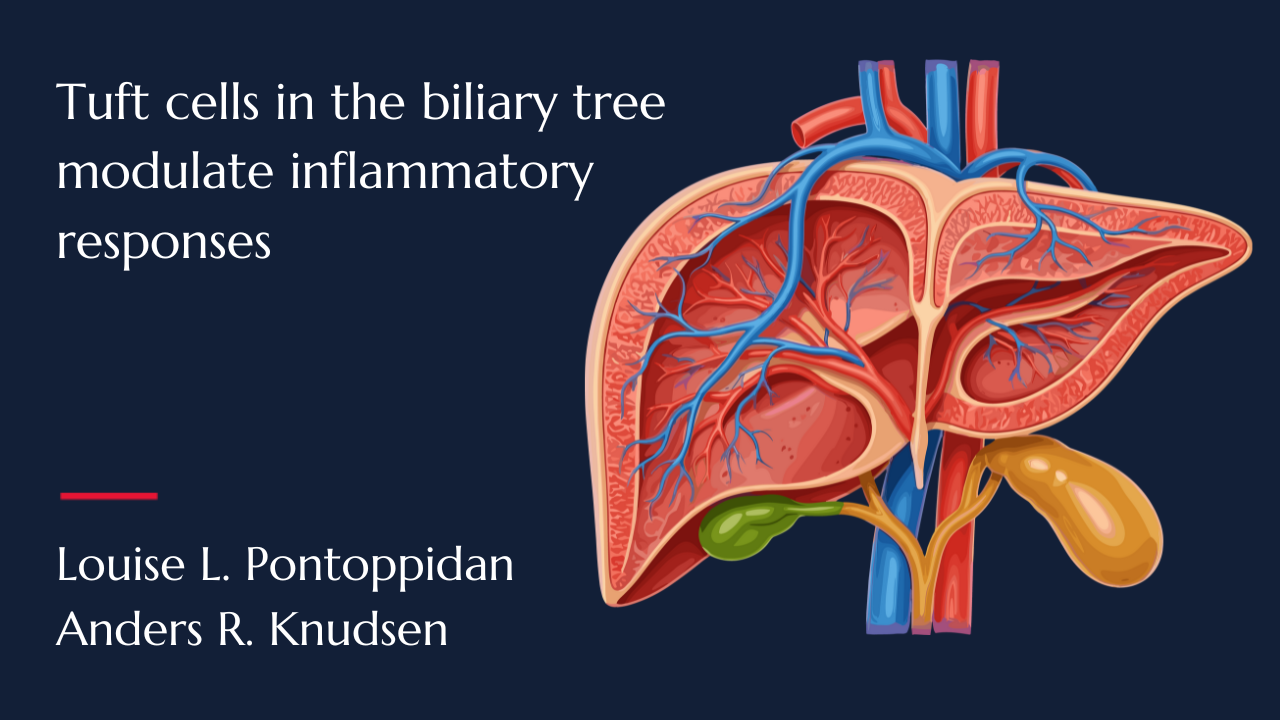
Inflammation of the extrahepatic biliary tree can lead to severe tissue damage causing fibrosis and impairment of liver function. Ultimately inflammation can progress to liver cirrhosis and liver failure or increase the risk of developing liver cancer1. Neutrophils are considered central mediators of inflammatory damage, and higher absolute neutrophil counts have been linked to poorer postoperative outcomes in patients undergoing surgical resection for cholangiocarcinoma2.
The study by O’Leary et al. aims to clarify how tuft cells within the extrahepatic biliary tree regulate neutrophil infiltration. Tuft cells are specialised chemosensory epithelial cells found in diverse tissues, including the airways, gastrointestinal tract, biliary epithelium, pancreas, and thymus3. They modulate immune responses through acetylcholine release, cytokine production, and synthesis of enzymes involved in the production of leukotrienes and prostaglandins. They also represent the exclusive epithelial source of IL-25, an IL-17 family cytokine that activates lamina propria Group 2 innate lymphoid cells (ILC2)4.
To determine how tuft cells are distributed within the extrahepatic biliary tree, O’Leary et al. employed IL-25 reporter mice and flow cytometry. Their data indicated that tuft cells were proportionally more abundant in the biliary epithelium than in the small intestine. To evaluate whether these cells represent the same lineage as intestinal tuft cells, the authors conducted a comparative gene-expression analysis. This revealed a shared core transcriptional programme, although biliary tuft cells also exhibited a distinct signature enriched for genes involved in axon guidance, neural development, immune pathways, and cholesterol metabolism.
In the small intestine, tuft-cell differentiation has been linked to a feedback loop involving ILC2 cells5. O’Leary et al. investigated whether a similar mechanism can be found in the biliary tree. They found that ILC2 levels were unchanged in mice lacking biliary tuft cells compared with controls. Conversely, mice deficient in ILC2 cells displayed normal biliary tuft-cell abundance. These findings suggest that, unlike in the intestine, tuft-cell differentiation in the biliary tree may be regulated by factors other than ILC2-derived cytokines.
To assess the lifespan of biliary tuft cells, O’Leary et al. first validated doublecortin-like kinase 1 (DCLK1) as a reliable marker. In DCLK1-labelled mice, biliary tuft cells appeared long-lived, persisting for up to six months. In contrast, tuft-cell recovery after depletion was slow, requiring approximately 3–6 months. The authors also observed that neonatal mice exhibited markedly higher tuft-cell abundance than adults, with levels declining to adult values by around six weeks of age. This temporal pattern suggested that distinct regulatory mechanisms may govern biliary tuft-cell homeostasis. Because this developmental decline coincides with the shift from milk to solid food and the maturation of enterohepatic bile acid (BA) circulation, the authors investigated whether BAs contribute to tuft-cell regulation. In mice fed cholestyramine—which indirectly reduces BA synthesis through suppression of FXR signalling—biliary tuft cells were nearly eliminated. However, when FXR was systemically activated in cholestyramine-treated mice, biliary tuft-cell numbers were preserved, supporting a role for BA levels in maintaining biliary tuft-cell abundance.
Primary bile acids are produced by the liver, while secondary bile acids are formed by colonic bacteria. Cholic acid (CA), a primary BA, rises in response to cholestyramine and decreases with FXR activation. O’Leary et al. demonstrated that dietary CA increased biliary CA and nearly eliminated biliary tuft cells, whereas small-intestinal tuft cells were unchanged. Deoxycholic acid (DCA), a secondary BA, was also elevated under these conditions, and feeding DCA similarly reduced biliary tuft cells. Since DCA generation depends on the microbiota, the authors evaluated germ-free mice, in which CA-induced tuft-cell loss was delayed. Their findings overall support a model in which CA and its microbial metabolites play a central role in regulating biliary tuft-cell abundance.
The authors next explored whether tuft cells affect inflammatory responses during bile duct ligation (BDL), a model that provokes cholestatic injury and inflammation. In tuft-cell–deficient mice subjected to BDL, modestly increased mortality, weight loss, and enhanced immune-cell infiltration were observed. To distinguish effects attributable to tuft-cell absence rather than BDL, the authors studied tuft-cell–deficient mice under basal conditions and found spontaneous accumulation of immune cells, with neutrophils predominating. When biliary tuft cells were experimentally depleted in wild-type mice, neutrophil infiltration likewise increased, suggesting that reduced tuft-cell abundance may predispose to heightened neutrophil recruitment. Notably, elevated bile acids—previously shown to diminish tuft-cell numbers—resulted in reduced neutrophil levels, contrary to the pattern observed with genetic or experimental tuft-cell loss. Prolonged CA feeding similarly lowered neutrophil counts in tuft-cell–deficient mice, indicating that BA exposure may exert neutrophil-modulating effects independent of tuft-cell abundance.
To further characterize the immune alterations associated with tuft-cell deficiency, O’Leary et al. performed scRNA-seq on biliary immune cells from tuft-cell–deficient and control mice. In knock-out mice, neutrophils constituted the predominant immune population and exhibited enhanced chemotaxis and cytokine-response signatures, consistent with activation of inflammatory and antibacterial pathways. These findings prompted the authors to investigate whether the microbiome contributes to biliary neutrophil infiltration. Across several experiments comparing mice with distinct microbiotas and germ-free mice, microbiome composition markedly influenced immune-cell frequency. Transfer of defined microbial communities between mice was sufficient to induce neutrophil influx. Moreover, germ-free mice—which naturally display high biliary tuft-cell abundance—developed neutrophil infiltration and a reduction in tuft-cell numbers when colonized with small-intestinal contents from donors harbouring a neutrophil-promoting microbiota.
In summary, this study identifies a transcriptionally distinct population of tuft cells in the extrahepatic biliary tree and demonstrates that their abundance is closely linked to neutrophil recruitment. Biliary tuft-cell levels were shown to depend on bile-acid composition, which in turn is shaped partly by the intestinal microbiome. Both bile-acid perturbations and microbiome transfer experiments revealed that these factors can modulate biliary tuft-cell abundance and directly influence neutrophil infiltration. Collectively, the findings delineate an interconnected regulatory axis involving bile acids, the microbiome, and biliary tuft cells that governs neutrophil-driven inflammation.
The clinical significance of these findings is underscored by the fact that chronic biliary inflammation often contributes to fibrosis and progressive liver dysfunction, suggesting that elucidating the mechanisms governing tuft-cell–mediated neutrophil infiltration may yield insights relevant to preventing or treating fibrotic biliary diseases. In addition, biliary inflammation is closely linked to cancer risk1, and tuft cells have been associated with several malignancies, including pancreatic, colorectal, and hepatic cancers6. Together, these observations highlight the importance of defining tuft-cell localization and function to inform therapeutic strategies aimed at limiting tumorigenesis within the biliary system and related tissues.
Several limitations should be considered when interpreting these findings. First, the study was performed in mice, and tuft-cell distribution in humans appears to differ substantially; in humans, tuft cells are relatively sparse in the biliary system and are reportedly absent from the common bile duct 7. Second, although there are some similarities, the composition of bile acids differs between mice and humans 8, which may influence tuft-cell regulation and inflammatory responses. Third, interspecies differences in the microbiome, partly driven by dietary variation—such as the high-fiber diet of laboratory mice compared with typical human diets—may affect the applicability of these results to human physiology.
In conclusion, while caution is warranted when extrapolating to humans, the study delineates key mechanisms controlling tuft-cell abundance and neutrophil infiltration, providing a framework for future studies targeting biliary inflammation and fibrosis.
References
1.Tsai TY, Lin CC, Peng CY, Huang WH, Su WP, Lai SW, et al. The association between biliary tract inflammation and risk of digestive system cancers. Medicine (Baltimore). 2016;95:e4427. doi:10.1097/MD.0000000000004427
2.Watanabe A, Harimoto N, Araki K, Kubo N, Igarashi T, Tsukagoshi M, et al. Absolute Neutrophil Count Predicts Postoperative Prognosis in Mass-forming Intrahepatic Cholangiocarcinoma. Anticancer Res. 2019;39:941-947. doi:10.21873/anticanres.13197
3.Nevo S, Kadouri N, Abramson J. Tuft cells: From the mucosa to the thymus. Immunol Lett. 2019;210:1-9. doi:10.1016/j.imlet.2019.02.003
4.Schneider C, O’Leary CE, Locksley RM. Regulation of immune responses by tuft cells. Nat Rev Immunol. 2019;19:584-593. doi:10.1038/s41577-019-0176-x
5.Kotas ME, O’Leary CE, Locksley RM. Tuft cells: Context specific programming for a conserved cell lineage. Annu Rev Pathol. 2023;18:311-335. doi:10.1146/annurev-pathol-042320-112212
6.Li L, Ma M, Duan T, Sui X. The critical roles and therapeutic implications of tuft cells in cancer. Front Pharmacol. 2022;13:1047188. doi:10.3389/fphar.2022.1047188
7.Schütz B, Ruppert AL, Strobel O, Lazarus M, Urade Y, Büchler MW, et al. Distribution pattern and molecular signature of cholinergic tuft cells in human gastro-intestinal and pancreatic-biliary tract. Sci Rep. 2019;9:17466. doi:10.1038/s41598-019-53997-3
8.Gijbels E, Pieters A, De Muynck K, Vinken M, Devisscher L. Rodent models of cholestatic liver disease: A practical guide for translational research. Liver Int. 2021;41:656-682. doi:10.1111/liv.14800




.png)





.jpg)

