
Every surgeon should know about spontaneous interjection exclamations, at least the following:
1. avoid them in certain situations
2. observe them in your patients.
An interjection is a short vocal expression, an audible element of feeling or expression of reaction1. They are short. They can be stratified as votive interjections as in instructions such as Shh meaning be quiet, emotive interjections expressing emotions such as disgust yuk and cognitive interjections expressing emotions related to cognition, like wow expressing surprise1. Interjections are context and intonation dependent2. An example is oh, that can be express both surprise and disappointment. Emotive interjections are spontaneous reactions to situations3.
Regarding the surgeon, spontaneous interjection exclamations when something surprising or unexpected happens - interjections such as oops and eek - should be avoided at all costs especially during local anaesthesia procedures. Using such interjections may increase the patient's stress and cause doubt about the correct course of the procedure. It is more advisable to communicate during the procedure in a calm voice as it progresses and thus increase the patient's trust in the surgeon and the procedure. Usually, a calm voice is also deeper. Somehow, we link deeper voice to authority, dominance and trustworthiness4. When I am in tough spot during surgery, I have noticed that my voice deepens, though not to Barry White level.
Pain is an individual, subjective, and highly personal experience. Without communicating pain, vocally or physically, it is almost impossible for the outsider to gather information about the internal state of an individual. Physical expressions of pain such as facial movements5 or the withdrawal reflex6 are familiar to us surgeons. Vocal expressions of pain are strangely enough less studied than facial expression of pain7. Crying, moaning, groaning sighing and verbalization7 are expressions of pain; likewise swearing8. Interjections such as ow9 and ouch are used to express sudden and sharp pain10. It is good practice to warn a patient when starting to inject local anaesthetic.
I was talking with a colleague about interjections, and he brought to my attention this typical scenario in the theatre. We all have been in a situation as surgeons where we must be able to hear (at least) three conversations at once in theatre. It could be hearing a nurse wondering where a swab is, or the anaesthetist asking whether there is adrenaline nearby. Also, each of us has our own interjection for trouble looming ranging from one colleague who used to say f**k five times very quickly, to another who just used to say quietly: uh-oh.
There is a meme that says: Don’t trust a surgeon that does not drink coffee and say f*** a lot. As far as I am concerned, this fits quite well to the majority of surgeons I know. Similarly, it fits to most of the people I know who are not surgeons, at least the coffee part. I was astounded to find out how many positive actions swearing produces in our bodies and minds. Swearing increases pain tolerance and pain threshold, and simultaneously reduces pain perception It increases power and strength in physical activity tasks and is powerful emotional expression, both in positive and negative interpersonal interactions11. Dare I say it, should I be swearing a lot more?
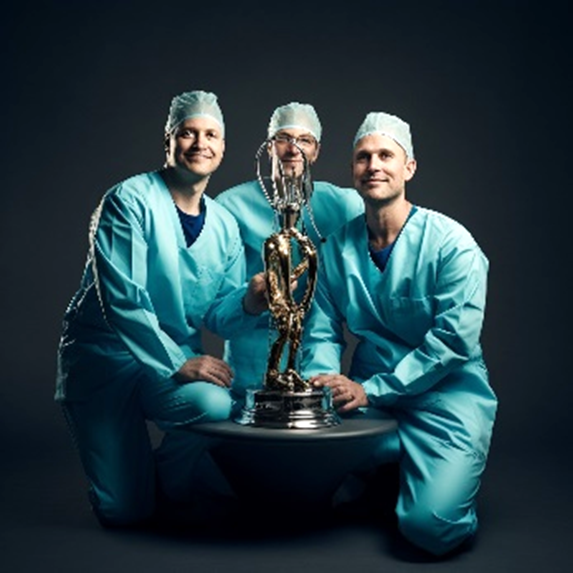
Is it a myth that we surgeons swear a lot? Palazzo and Warner tackled this topic in 199912. Their Medline literature search using words swear, swearing, foul language, and blasphemy retrieved no relevant articles12. Of course, I was intrigued to repeat their review, after all, 25 years have passed. I came to a fairly similar conclusion, just one relevant publication: theirs. Palazzo and Warner were not discouraged and came up with an observational study setting. They observed 100 consecutive elective operations under general anaesthesia, totalling 80 hours and 30 minutes. They recorded a swear word mean every 51.4 minutes and found that specialties had different swearing rates. Orthopaedics won the gold medal (congratulations!), and at least to my surprise, gynaecology took the bronze. Oh! You want to know who earned the silver medal – general surgeons.
Let's broaden the perspective, what about when the patient is not under general anaesthesia? A study from the US, showed that for all doctors, not just surgeons, swearing was considered less likeable, less trustworthy and less expert13. However, the study showed that an apology immediately after using a swearword reduced the negative impact of swearing13.
Finally, I leave you with words of wisdom to ponder in those lone and long wee hours of the night: What is the difference between a resident and a specialist? Eek and aha.
References
Barret JP, Gomez P, Solano I, Gonzalez-Dorrego M, Crisol FJ. Epidemiology and mortality of adult burns in Catalonia. Burns 1999;25(4): 325-329.
Cuenca MJ. Defining the indefinable? Interjections. 2000.
Ameka F. Interjections: The universal yet neglected part of speech. Journal of pragmatics 1992;18(2-3): 101-118.
McAleer P, Todorov A, Belin P. How do you say ‘Hello’? Personality impressions from brief novel voices. PloS one 2014;9(3): e90779.
Kunz M, Meixner D, Lautenbacher S. Facial muscle movements encoding pain-a systematic review. Pain 2019;160(3): 535-549.
Derderian C, Tadi P. Physiology, withdrawal response. In: StatPearls [Internet]. StatPearls Publishing, 2021.
Helmer LML, Weijenberg RAF, de Vries R, Achterberg WP, Lautenbacher S, Sampson EL, Lobbezoo F. Crying out in pain-A systematic review into the validity of vocalization as an indicator for pain. Eur J Pain 2020;24(9): 1703-1715.
Stephens R, Robertson O. Swearing as a response to pain: Assessing hypoalgesic effects of novel “swear” words. Frontiers in psychology 2020;11: 723.
Stanford EA, Chambers CT, Craig KD, McGrath PJ, Cassidy KL. "Ow!": spontaneous verbal pain expression among young children during immunization. Clin J Pain 2005;21(6): 499-502.
Ameka FK. Interjections. In: Encyclopedia of language & linguistics. Elsevier, 2006; 743-746.
Stapleton K, Fägersten KB, Stephens R, Loveday C. The power of swearing: What we know and what we don’t. Lingua 2022;277: 103406.
Palazzo FF, Warner OJ. Surgeons swear when operating: fact or myth? BMJ 1999;319(7225): 1611.
Perrault EK, Barton JA, Hildenbrand GM, McCullock SP, Lee DG, Adu Gyamfi P. When doctors swear, do patients care? Two experiments examining physicians cursing in the presence of patients. Health Communication 2022;37(6): 739-747.
.png)



.jpg)

