
Adverse events: normal reactions to challenging situations
Surgeons will inevitably face an adverse event at some point during their careers. Adverse events can be conceptualised broadly as ‘any serious or significant event during surgical care that causes the surgeon significant distress’1 and can cover a whole spectrum of events, including surgical complications and surgical errors. Sadly, these events are common and inescapable- in a recent survey, 80% of surgeons (across levels of seniority) reported experiencing an interoperative adverse event in the last year2. Of course, the primary focus following an adverse event should be sensitive in addressing the impact for the patient and their family. However, surgeons are profoundly affected too; in a survey of surgeons’ experiences following an adverse event (n=445) 48% reported increased anxiety, 43% reported problems sleeping, 15% reported relationship difficulties, and around a third reported clinical levels of post-traumatic stress3,4. Adverse events in healthcare workers are also linked to reduced confidence, lower work performance, increased absenteeism, and, in extreme cases, suicide5.
Common cognitive, physical, emotional, and behavioural reactions to adverse events6
It is perhaps surprising then, that there is often little preparation, training, or support, for surgeons around adverse events- particularly focusing on how to navigate these events and their psychological impact. Surgeons generally report feeling under prepared for adverse events by their training, and particularly ill-prepared for dealing with errors4. Surgeons may be more equipped practically for what an adverse event might look like, than for the ‘felt sense’, or personal impact, that an adverse event might have- the distress, guilt, shame, anger, sadness, sense of ‘failure’, the rumination about the impact for the patient, the ‘what could I have done differently?’, the ‘what does this say about me?’… and the impact on relationships within the team, such as perceived credibility and competence.
While surgical errors tend to have a greater impact on surgeons than complications4 the objective severity of the event does not necessarily correlate with the extent that the event will cause a surgeon distress. It is not just the nature of the event that is important- it is also the meaning and context of the event that matters. For example, a patient death may be appraised as ‘sad but inevitable’, whereas a small mistake in surgery which did not change the patient outcome could be interpreted by the surgeon as a sign that they are ‘inept’, ‘inadequate’ or ‘not cut out for this’.
There may also be a misguided sense that with experience and seniority, surgeons will not or ‘should not’ be affected by adverse events, and yet, we know clinically, that senior surgeons can be affected just as much by these experiences. Even the most adept and confident surgeon may be plagued by the memories of past adverse events even years later. As the French surgeon, René Leriche, once said “Every surgeon carries within himself a small cemetery, where from time to time he goes to pray-a place of bitterness and regret, where he must look for an explanation for his failures”.
Although surgeons can feel alone in their experience and response to adverse events, research shows that there are common human responses. Scott and colleagues7 describe a six-stage trajectory of responses to adverse events, comprising: 1) chaos and accident response, 2) intrusive reflections, 3) restoring personal integrity, 4) enduring the inquisition, 5) obtaining emotional first aid, and 6) moving on.
Scott et al.’s model: common responses to adverse events7
Similarly, Luu and colleagues8 identified four phases repeatedly described by surgeons after experiences of adverse events:
The initial feelings of failure (the kick)
The assessment of their role in the event, often accompanied by feelings of spiralling out of control (the fall)
A reflection phase (the recovery)
The cumulative/long-term effects (long-term impact).
For some, this latter phase involved changing the type of surgery or scope of their practice to avoid the event happening again, while acknowledging the huge cost that the impact of these (sometimes cumulative) events had on their identity and wellbeing.
Luu et al.’s model: the long-term impact of adverse events for surgeons8
Why don’t surgeons talk about adverse events?
We know that many surgeons want better support following adverse events. However, we also know that surgeons often find it hard to seek or receive such support.While sharing experiences and compassionate conversations are valuable in the aftermath of adverse events, stigma and shame are huge barriers to support-seeking in surgery. In our survey of surgeons (n=445), 42.5% did not speak to anyone at all following their experience of an adverse event, despite the detrimental impact that the event had for them.
The culture in surgery does not generally facilitate transparency and openness about adverse events9; In our more recent work, 57% of surgeons (n=154) reported that showing vulnerability as a surgeon carries a stigma, with 25% reporting that showing vulnerability is a ‘sign of weakness’. Admitting mistakes, showing vulnerability and acknowledging human fallibility as a surgeon are not easy; “staying silent about everything you do wrong and only talking about successful operations is very common in [surgery]”10.
Options for support-levels of response
What is clear is that adverse events significantly affect surgeons, patient safety, and the wider team. What is less clear is how to better support surgeons after things go wrong, in terms of what surgeons will find acceptable and useful. However, it is important to move beyond the traditional focus based on individual resilience, as we know that peer support as well as contextual factors can play a key role in the experience following an adverse event, and the trajectory of recovery. We propose three key areas for any surgeon support pathway. This includes responsive and specialist support, as well as support before adverse events happen:
Preventative – This includes: (1) Training all colleagues within the multidisciplinary team in normal reactions to adverse events, self-care and team care (2) Training in psychologically safe team cultures, where people feel able to speak up when they have concerns or ideas, without fear of being humiliated. Psychological safety has been shown to improve team connection and performance11 and there is evidence of the impact that training of this nature can have on the wider culture around adverse events12 especially if it is integrated into existing processes, e.g. team briefings. Training should include managers and the wider team, not just surgeons. Further, those in leadership positions have the potential to set the tone for how others can respond more helpfully after an adverse event.
Responsive - Peer-support is the preferred mode of support reported by healthcare workers following an adverse event6. Three key strands include: (1) one-to-one peer led check ins, for example the Royal College of Surgeons SUPPORT programme, where surgeons trained in post adverse event support provide confidential check-in conversations focused on the affected surgeon’s wellbeing; (2) peer-led debriefs, which focus on team connection, and coping, so that the team can continue with their shifts, and are aware of how to access additional support as needed. For example, North Bristol NHS Trust’s Staff Psychology Team and clinicians developed peer-led PITSTOPs, a team wellbeing-focused hot debrief model, that forms part of a wider Staff Trauma Support pathway; (3) psychologically-safe forums to discuss and learn from complications and errors, including morbidity and mortality meetings, with opportunities to consider the surgeon and surgical team’s wellbeing, alongside what the team can learn moving forwards. Surgeons are likely to experience a heightened stress response after an adverse event, so it is imperative that the focus is initially on their wellbeing and coping, before focusing on learning and investigation processes. This is both to support the surgeon themselves, and so that they are in a better position to engage with wider processes.
Specialist – The aim is that preventative and responsive measures will help to reduce the distress and wider impact associated with adverse events. However, a minority of individuals may experience heightened and persisting distress that warrants more specialist psychological support. This should include access to in-house trauma focused psychological interventions (where this is available), for example eye movement desensitisation and reprocessing (EMDR) or support through external organisations, such as Practitioner Health.
In the light of the historical low update of generic psychologically-informed approaches by surgeons, and the reported stigma associated with support seeking, it seems important for any support strands to be co-developed and co-led with surgeons, for surgeons, so that they are tailored to the unique surgical context, and are experienced as credible, helpful, and accessible.
In our experience, it tends to be surgeons who have had a personal experience of an adverse event who then champion the need for support. But arguably this needs to be everyone’s business and should be a core part of surgical training. This would ensure that all surgeons are better prepared, both for when they might experience an adverse event, and importantly, to support those around them who may also be affected.
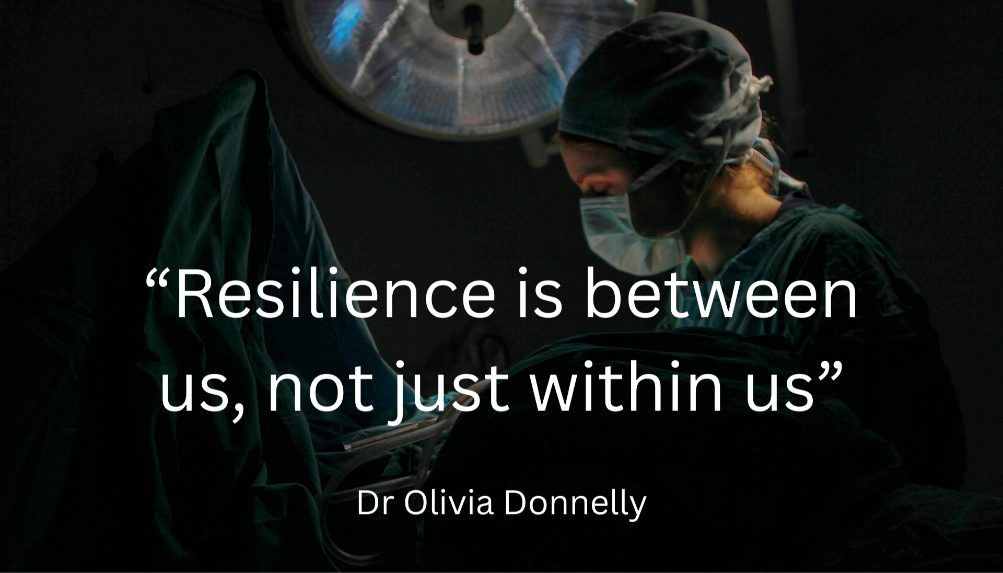
The impact of adverse events can be significant, and so we need to work together to further develop individual, team, and organisational approaches that make a meaningful difference. Because ‘resilience is between us, not just within us’.
Tips for coping after an adverse event, individually and within your team
Adverse events (complications, errors, near misses) happen during clinical practice for all surgeons, whether that’s personally or within the team. Being prepared for how to respond to these at an individual, team, and organisational level is important, and highlights a culture of care of ‘how we do things here’.
You are likely to experience a range of emotions, cognitions, or physicalreactions, after an adverse event. It is important to remember that many responses are normal reactions to challenging situations and are often signs of the mind processing what has happened.
It is not always clear how someone is feeling after an adverse event. Don’t compare your inside experience to someone else’s outside appearance. The best way to understand how someone is feeling is to ask them.
There are a range of factors that can lead colleagues to want to avoid talking about what has happened. However, avoidance can exacerbate distress. Conversely, talking with supportive peers, who understand the context, can make a big difference in how you cope following an adverse event.
Fostering a culture of support is about small actions we can all take (e.g.routinely checking in with colleagues, including those in more senior roles) that can have a big impact.
Those in leadership positions are ‘culture carriers’. How you respond during and after adverse events will set the tone for more junior colleagues. For example, when you reach out to a peer for support, this gives permission for others to do the same.
Weave wellbeing into routine processes, e.g. considering the emotional impact of adverse events, and associated support during M&M meetings. Ensure that surgeons are part of developing and leading approaches, as part of increasing engagement and credibility.
____________
The Royal College of Surgeons is currently recruiting trust sites to join the second phase of the SUPPORT collaborative. If you are interested find out more here: The RCS England SUPPORT Improvement Collaborative — Royal College of Surgeons
References
1.Royal College of Surgeons of England; A Guide to Good Practice. Supporting Surgeons After Adverse Events. 2020. Available from: Supporting surgeons after adverse events — Royal College of Surgeons
2.Han K, Bohnen JD, Peponis T, Martinez M, Nandan A, Yeh DD, et al. The Surgeon as the Second Victim? Results of the Boston Intraoperative Adverse Events Surgeons’ Attitude (BISA) Study. J Am Coll Surg. 2017;224(6):1048–56. Available from: https://www.sciencedirect.com/science/article/pii/S1072751517300352
3.O’Meara S, Doherty E, Walsh K. Where do we go from here? The personal impact of adverse events and complications in surgeons: Results from a cross-sectional study. The Surgeon. 2025 Apr;23(2):73–7.
4.Turner K, Bolderston H, Thomas K, Greville-Harris M, Withers C, McDougall S. Impact of adverse events on surgeons. British Journal of Surgery. 2022 Apr 2;109(4):308–10. Available from: https://doi.org/10.1093/bjs/znab447
5.Guerra-Paiva S, Lobão MJ, Simões DG, Fernandes J, Donato H, Carrillo I, et al. Key factors for effective implementation of healthcare workers support interventions after patient safety incidents in health organisations: a scoping review. BMJ Open. 2023 Dec 1;13(12):e078118. Available from: http://bmjopen.bmj.com/content/13/12/e078118.abstract
6.Simms-Ellis R, Harrison R, Sattar R, Sweeting E, Hartley H, Morys-Edge M, et al. Avoiding ‘second victims’ in healthcare: what support do staff want for coping with patient safety incidents, what do they get and is it effective? A systematic review. BMJ Open. 2025 Feb;15(2):e087512.
7.Scott SD, Hirschinger LE, Cox KR, McCoig M, Brandt J, Hall LW. The natural history of recovery for the healthcare provider “second victim” after adverse patient events. Qual Saf Health Care. 2009 Oct 1;18(5):325. Available from: http://qualitysafety.bmj.com/content/18/5/325.abstract
8.Luu S, Patel P, St-Martin L, Leung ASO, Regehr G, Murnaghan ML, et al. Waking up the next morning: surgeons’ emotional reactions to adverse events. Med Educ. 2012 Dec 1;46(12):1179–88. Available from: https://doi.org/10.1111/medu.12058
9.Kirsten Boyle Complications of surgery hurt – written by Miss Kirsten Boyle – Surgeons are human too
10.Øyri SF, Søreide K, Søreide E, Tjomsland O. Learning from experience: a qualitative study of surgeons’ perspectives on reporting and dealing with serious adverse events. BMJ Open Qual. 2023 Jun 7;12(2):e002368. Available from: https://doi.org/10.1136/bmjoq-2023-002368
11.Edmondson A, Bohmer R, Pisano G. Organisational Culture. Speeding up team learning. Harvard Business Review. 2001. Available from: Speeding Up Team Learning
12.Guerra-Paiva S, Lobão MJ, Simões DG, Fernandes J, Donato H, Carrillo I, et al. Key factors for effective implementation of healthcare workers support interventions after patient safety incidents in health organisations: a scoping review. BMJ Open. 2023 Dec 1;13(12):e078118. Available from: http://bmjopen.bmj.com/content/13/12/e078118.abstract

.png)





.jpg)

