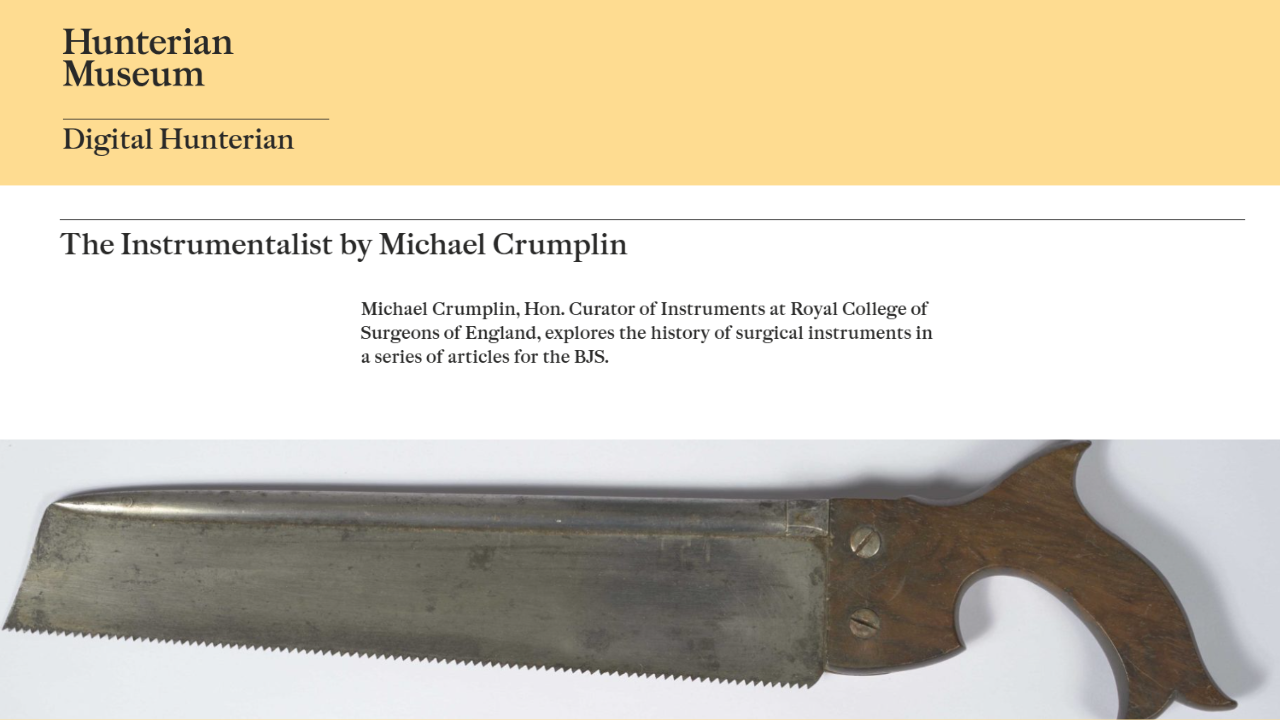
At the heart of the Royal College of Surgeons of England lies the Hunterian Museum, a space dedicated to the history of surgery from ancient times to the present day. Many visitors are drawn to the specimens on display - over 2,000 preparations of human and animal tissue collected by John Hunter in the 1700s. However, the story of surgery is equally told through the wealth of surgical instruments in the collection, from the simplest probes to the latest minimally invasive technologies.
Mick Crumplin, a retired surgeon and Honorary Curator of Instruments at the Royal College of Surgeons of England, delves into this fascinating history in his series of 20 articles for ‘The Instrumentalist’ in the BJS. This brilliant resource reviews the origin of a wide range of instruments, some of which will be very familiar to today’s surgeons, while others are less well-known.
Liston pattern bone-cutting forceps. © 2014 All rights reserved. Courtesy of Surtex Instruments Ltd.
The historic instruments explored in these articles are a powerful reminder of the enduring principles of surgery. Take the Liston bone-cutting shears, originally designed in the early 1800s. While the materials and minor elements of the design have been refined, the fundamental need to cut through tough cortical bone remains the same. Similarly, McIndoe’s dressing forceps highlight the abiding need for delicate instruments. These forceps, which Sir Archibald McIndoe used during World War Two for intricate facial surgery, remain just as relevant today as they were then.
‘The Instrumentalist’ also demonstrates how historic instruments are a window into past surgical practices. A Smith-Petersen tri-fin nail is from a time when total hip replacements or hemi-arthroplasty were not the standard treatment for intracapsular femoral neck fractures. Similarly, Sauerbruch’s sternum cutter, used to open the chest by repeatedly closing the instrument until the bone was fully divided, is a reminder of surgery before electric machinery was available.
Smith-Petersen tri-fin pin (courtesy of the library of the Royal College of Surgeons of England).
These articles also reveal the people behind the many eponymous instruments still used by surgeons today. Some, like gynaecologist James Marion Simms, who operated without anaesthesia on enslaved people, are familiar due to the controversy associated with their names. Others, like Cecil Joll, who spent much of the Blitz sleeping at the heavily bombed Royal Free Hospital, should perhaps be better acknowledged. Then there are pioneers like Harold Gillies, who treated servicemen with facial injuries during the First World War, and whose contributions continue to be remembered, including in the Hunterian Museum.
Mick Crumplin’s articles are freely accessible on both the BJS website and the Hunterian Museum website. It's wonderful that the BJS is bringing the history of these instruments to a wider audience. I hope that the next time readers hold a surgical instrument in their hands, they will be inspired to learn more about its origin.


.png)





.jpg)