
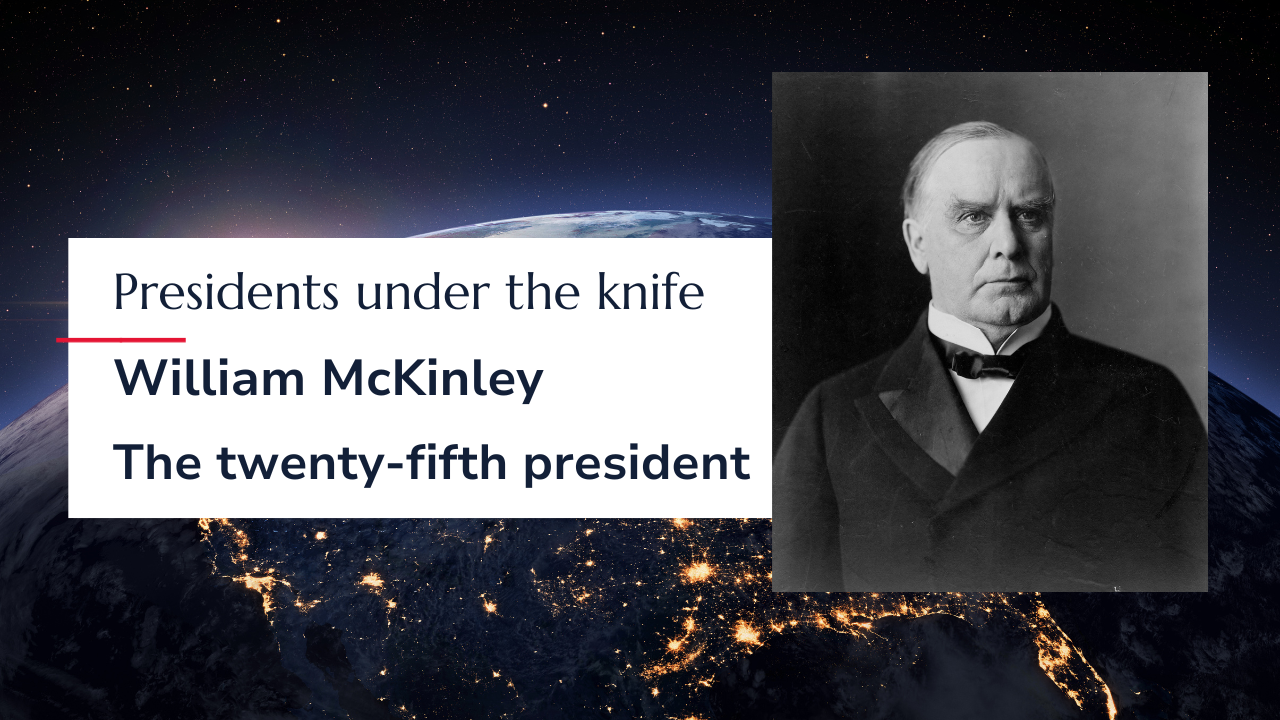
Photograph of President William McKinley. Wikipedia, in the public domain.
The twenty-fifth president:March 4, 1897 – September 14, 1901
It has been said about President McKinley that, when he was shot, he was brought to the wrong hospital and got the wrong operation by the wrong surgeon.1
McKinley was only six months into his second term when he became the third president to be shot and killed; this was a disturbing record for a country that was still young. Abraham Lincoln had been assassinated only thirty-six years prior, and many still remembered when their twentieth president, James Garfield, died with a bullet lodged in his body in 1881, only four months into his presidency.
The Pan-American Exposition of 1901
McKinley and his wife arrived by train to the Pan-American Exposition in Buffalo, New York, on the evening of September 4. The arrival at Buffalo was triumphant.2 The following day was scheduled to be The President’s Day, giving McKinley an opportunity to give a speech at the fairgrounds in front of 50,000 cheering spectators. The speech was focused on reciprocal tariffs and treaties and would be the President’s last public oration.
The Temple of Music, a prominent building at the Exposition, was the place where McKinley would shake hands with a long line of admirers on the day after his speech. The President’s security detail was not happy with the location. There had been rumors about anarchist plots to kill McKinley. Fearing the safety of the President, voices were raised advising the McKinley to cancel the event. The President, however, refused to change his schedule: “Why should I? No one would wish to hurt me.”3
Large numbers of well-wishers waited in line to get close to the President and shake his hand. When the assassin to be, Leon Czolgosz, finally reached the front of the line, he had his right hand covered by a white handkerchief concealing a .32-caliber Iver Johnson revolver; the President might have thought that Czolgosz was injured and reached for his left hand. That’s when two shots rang out and the music stopped.
The Shooting of President McKinley at the Temple of Music on September 6, 1901. A tabloid illustration by T. Dart Walker. Library of Congress, Prints and Photographs Division, Washington, D.C.
People behind Czolgosz immediately realized what had happened and threw the shooter to the floor. He was disarmed and received heavy beatings from fists and the artillerymen’s rifle butts. The President was carried out and loaded onto the prototype electricity-powered ambulance displayed at the fair and rushed to the Exposition Emergency Hospital.
The prototype electric ambulance exhibited at the Pan-American Exposition of 1901. Library of Congress, Prints and Photographs Division, Washington, D.C.
The news about the shooting of McKkinley spread like wildfire. On Saturday morning, big headlines were on the front pages of newspapers all over the country. The name of the perpetrator was known immediately and the fact that he was an anarchist was trumpeted out. Despite having received two shots, the initial reporting on McKinley’s condition was hopeful. The developments over the next week were widely covered by the press, and when the President’s condition worsened, everybody was pausing. His death would mourned by the whole nation.
Baltimore Sun, Saturday, September 7, 1901.
The surgery
When McKinley arrived at the Exposition Hospital, nurses immediately set up the operating room and commenced a frantic search for doctors. One of the most famous physicians in Buffalo at the time was Dr. Roswell Park. He was an expert surgeon and had experience with trauma and abdominal gunshot wounds and he was the medical director of the Exposition. He would have been the obvious choice if surgery would be needed. Unfortunately, however, he was out of town, performing an operation in a hospital at Niagara Falls.
Instead, Dr. Matthew Mann, an eminent gynecologist at Buffalo General Hospital and a Professor of Gynecology at the Buffalo Medical College and was at the Exposition on the day of the shooting, was chosen to be in charge of the President’s surgery. Although an accomplished surgeon, Mann did not have any expertise in upper abdominal surgery and had no previous experience with abdominal gunshot wounds. He was assisted by three other surgeons who happened to be visiting the Exposition at the time. The surgical team was also joined by seven nurses and by McKinley’s personal physician.
One hour and twenty-two minutes after the President was shot, Mann made an approximately 10 cm vertical incision in the abdominal wall, starting at the edge of the ribs and extending downwards just past the bullet wound. The surgery was challenging for several reasons. The President was obese. When Mann later commented on the surgery, he mentioned that “The greatest difficulty was the great size of President McKinley’s abdomen”4 with thick layers of fat both in the abdominal wall and inside the abdomen; “The omentum was enormously thickened with fat and very rigid.”
The lack of adequate surgical instruments, in particular retractors, added to the difficulties. Insufficient lighting in the operating room was also a big problem. Although a multitude of electrical lights had been installed all over the Exposition, none had been placed at the hospital.
The operation revealed that a ball had perforated the anterior wall of the stomach and traversed the stomach to exit through the posterior wall, creating a hole there as well. Both wounds were closed with double layers of fine black silk sutures. The surgeons were unable to find the bullet. Despite the fact that an x-ray machine displayed at the fair might have become useful in the search for the bullet that killed the President, the machine was not brought into action. When Mann continued the exploration by introducing “his arm so as to palpate carefully all the deep structures behind the stomach … no trace of the bullet … could be found.” Digging deeper had “a bad influence on the President’s pulse,” so the surgical team decided to end the operation. The procedure had lasted “one hour and 31 minutes.”4
In the morning of Thursday September 12, the sixth postoperative day, McKinley looked and felt good, and his doctors commented that, “The President now seemed at his best and his condition to warrant the favorable prognosis given out.”4 To emphasize how optimistic they felt, they added, “The time for peritonitis and sepsis had passed… His spirits were good and his mind clear.” Dr. Charles McBurney of New York (the surgeon who defined the “McBurney’s point”) who had been consulted by the surgical team in Buffalo, did not feel he was needed any longer. He left Buffalo in the morning, “having arranged to return at once if his presence was desired.”
Sadly, the rosy picture was about to change dramatically. It was only a couple of hours after McBurney left that “it was noticed that the character of the pulse was not quite so good.” The temperature kept rising and McKinley could no longer tolerate fluid by mouth. His condition deteriorated rapidly. The President died in the wee hours of Saturday, September 14, eight days after being shot.
After McKinley’s death, his surgeons were criticized by some for not bringing the President to the Buffalo General Hospital where a larger and better equipped operating theater would be available than the one at the Exposition Emergency Hospital. Others questioned why a drain was not placed at the time of surgery behind the stomach and close to the pancreas. Critical voices also wondered why a gynecologist had been appointed to be the lead surgeon rather than a surgeon experienced in upper abdominal surgery.
After racing through the morning hours by train, McKinley’s Vice President, Theodor Roosevelt, managed to reach Buffalo at 1:30 p.m. on September14. McKinley had then been dead for almost twelve hours. Roosevelt took the oath of office from a local judge to become the twenty-sixth president of the United States.
McKinley’s autopsy findings were summarized as, “Gunshot wound of both walls of the stomach and the superior aspect of the left kidney; extensive necrosis of the substance of the pancreas; necrosis of the gastric wall in the neighborhood of both wounds.”4
Czolgosz’s murder trial began nine days after McKinley died. At the trial, which was described as “quick, swift, and fair,”5 Czolgosz was found guilty and condemned to execution in the electric chair.
____________
This post contains material from Presidents Under the Knife: Surgical Successes, Failures and Deceptions. © 2025 Per-Olof Hasselgren by permission of McFarland & Company, Inc., Box 611, Jefferson, NC 28640
References
1.Pappas, Theodore, and Swanson, Sven. Anarchy and the surgical care of President McKinley. J Trauma 2012;72:1106-1113
2.Adler, Selig. The operation on President McKinley. Scientific American 1963;208:118-131
3.Leech, Margaret. In the Days of McKinley. New York: Harper and Brothers, 1959
4.Rixey, Presley M., et al. The official report on the case of President McKinley. Special Contribution. Buffalo Medical Journal, October 1901:271-293
5.Briggs, L. Vernon. The Manner of Man That Kills: Spencer, Czolgosz, Richeson. Charleston, SC: BiblioLife 2009, originally published by Richard G. Badger, Boston, MA, 1921



.png)





.jpg)

