
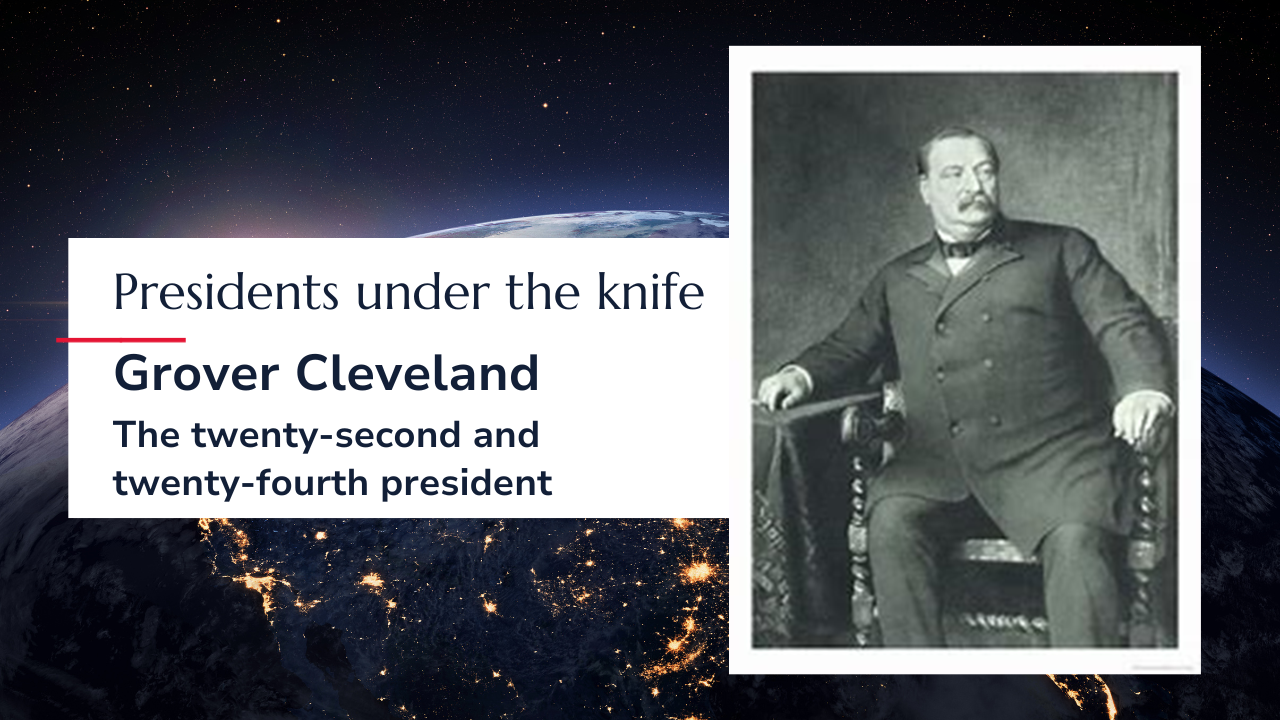
Official portrait of President Cleveland by Eastman Johnson (1824-1906) in 1891. Grover Cleveland was the twenty-second president (March 4, 1885 – March 4, 1889) and the twenty-fourth president (March 4, 1893 – March 4, 1897). The image shows a morbidly obese Cleveland, who was weighing close to 300 pounds and would undergo major and risky surgery about two years later. Alamy Stock Photo. Credit: NMUIM.
The president with a rough spot on the roof of his mouth
When Grover Cleveland was sworn in as president on March 4, 1893, he was the first – and until recently the only - president with two nonconsecutive terms. The weather on the day of Cleveland’s repeat inauguration was miserable, described by one congressman to be “as bad as mortal man ever endured, windy, stormy, sleety, icy.”1 But it was not only the weather that was nasty; the political and economic climate in the country was depressing as well. The Panic of 1893 was already underway. Citizens out of work and lacking food were roaming the streets of American cities and the trust in the federal gold reserve was quickly evaporating.
In an effort to unite the divided Democrats, the party leaders had picked Adlai Stevenson as Cleveland’s running mate, resulting in a ticket with two individuals at each other’s throat and holding radically different views on fiscal policies. The re-elected president was a conservative “sound money man” or “gold bug” who favored the gold standard and despised “the waste of public money.” He needed to gain support in congress for his programs and win over Stevenson’s supporters to be able to repeal the Sherman Silver Purchase Act. Cleveland understood that it was essential to look strong and healthy in the upcoming political fight. More than ever, the country needed a powerful and vigorous leader, and any question about the president’s health could make the political and economic situation worse.
A rough spot on the roof of his mouth
Therefore, when only two months into his second term, Cleveland felt a “rough spot” on the roof of his mouth, he became alarmed and asked his physician to take a look. The doctor saw “an ulcerative surface nearly as large as a quarter with cauliflower granulations and crater edges.”2 He scraped some tissue off the lesion and sent it for microscopic testing. Pathologists, uninformed about the patient’s identity, reported that it was probable that “the specimens are from a case of epithelioma.” In other words, the lesion “presumably could be cancerous.”
Cleveland’s White House physician consulted Dr. Joseph Bryant, a famous surgeon at the Bellevue Hospital in New York and a good friend of Cleveland and his wife. When Bryant examined the president, he felt convinced that what he saw was a malignant tumor and that surgery would be needed. Bryant commented that, “To one familiar with the macroscopical appearance of epithelial growths, no reasonable doubt could exist in his mind regarding the certainty of the malignant nature of this.” Cleveland, who sensed that Bryant was concerned, asked, “What do you think it is, Doctor?” The surgeon replied: “It is a bad looking tenant. Were it in my mouth I would have it removed at once.”
Realizing what Bryant had found and that surgery would be recommended, Cleveland panicked, not only for having a disease that could threaten his life, but also for the political ramifications if his condition and upcoming surgery became known to the public. He was adamant that the surgery must take place out of the view of the press and swore his doctors to secrecy. Nothing could be noticed on the president revealing that something had happened to him. No visible scars would be tolerated – and the moustache needed to stay!
In addition to keeping the surgery hidden, it was also a matter of finding a secret place for the operation. Elias Cornelius Benedict was a wealthy banker and industrialist in New York City. He was one of Cleveland’s close friends and supporters and owned a luxurious steam yacht, the Oneida. The plot was to fake a fishing trip on the Oneida along the east coast from New York up to Cleveland’s summer residence at Buzzards Bay. The surgery was scheduled to take place on Saturday, July 1, in the yacht’s saloon that was converted into an “operating room.”
Cleveland’s surgery took place on the yacht Oneida on July 1, 1893. The Oneida was one of the most spectacular yachts of the Gilded Age. It was fast and luxurious. Library of Congress, Prints and Photographs Division, Washington, D.C.
The operation
A group of six physicians assembled in secrecy on the Oneida to operate on the president was led by Dr. Bryant. He had impressive credentials as an expert on oral cancers. (3) Bryant had great respect for the procedure that was being planned - removal of a major part of the left upper jaw, maxilla - and commented that it was indeed a “formidable” operation. In addition to facial deformity and recurrence of the disease, Bryant mentioned that “profuse” and “dangerous haemorrhage” was among the immediate threats of the operation. The other members of Bryant’s team included two additional surgeons, one dentist, one internist, and the White House physician who had been the first to identify Cleveland’s tumor.
Shortly after noon on July 1, Cleveland emerged from his cabin where he had undressed down to his underwear. He made his way to the “operating room” where he was positioned for surgery. At 12:32 pm, a mask was placed across the president’s face and nitrous oxide was administered. When the patient appeared to be anesthetized enough, two of the president’s teeth were extracted from the left upper jaw.
At 12:47 pm, cocaine was injected around the tumor as a local anesthetic but also to reduce blood flow to the area. The nitrous oxide was switched to ether to keep the president pain free. At 1:14 pm, Bryant started the removal of the tumor together with the nearby portions of the hard palate and a segment of the left maxilla with three additional teeth. The surgeon used “a surgical hammer, chisel, and bone-cutting instruments.”4 With the removal of a major part of the hard palate, the nasal cavity and maxillary sinus were entered, creating “the worst imaginable case of cleft palate.” The hole in the roof of the mouth was covered with a rubber prosthesis after the operation to restore the voice to near normal.
At 1:55 pm, an hour and a half after the surgery had started, it was over. By now, the surgeons had removed the tumor with a significant part of the hard palate and left upper jaw and a total of five teeth. All this had been done from inside the mouth without leaving any visible scars – and with the president’s moustache still in place!
Casts of Cleveland’s mouth used to make a rubber prosthesis to cover the defect in the roof of the mouth created by his surgery. The two casts were made with four years interval (1893 and 1897) and the picture illustrates the remarkable healing of the initial defect that measured 2 ½ inch in length and 13/16 inch in width shortly after the surgery (left panel) and 11/16 by 7/16 inch in 1897 (right panel). Credit: New York Academy of Medicine Library.
Despite the dangerous operation performed under less than optimal conditions on a high-risk patient (morbidly obese, cigar smoker, and whiskey and beer lover), Cleveland did not only survive the surgery but did so with flying colors. He was out of bed in the evening the first postoperative day and, on Monday, he was walking about the yacht. Indeed, a remarkable bouncing back!
Deceptions
The Oneida arrived at Buzzards Bay in the evening of July 5. The members of the press had become suspicious why it had taken Cleveland five days to reach Buzzards Bay from New York instead of the expected fifteen hours. The reporters were lied to that the delay had happened because Cleveland and his company had “found good fishing grounds” on the way up from New York and that the president’s health was “excellent except that he was suffering from a slight attack of rheumatism.”
Political victory despite recent high-risk major surgery
The special session of Congress took place on August 8, just over a month after the president’s major and daring surgery.5 On November 1, Cleveland signed into law the decision to repeal the Sherman Silver Purchase Act. The outcome was described in the press a “a great personal victory for President Cleveland.”
______________
This post contains material from Presidents Under the Knife: Surgical Successes, Failures and Deceptions. © 2025 Per-Olof Hasselgren by permission of McFarland & Company, Inc., Box 611, Jefferson, NC 28640
References
1.) Algeo, Matthew. The President is a Sick Man. Chicago: Chicago Review Press, 2011
2.) MacMahon, Edward B., and Curry, Leonard. Medical Cover-Ups in the White House. Washington, D.C.: Farragut Publishing, 1987
3.) Bryant, Joseph D. On excision of the superior maxilla. A study of two hundred and fifty cases. Ann Surg 11:305-318, 1890
4.) Bumgarner, John R. The Health of the Presidents. Jefferson, North Carolina: McFarland & Company, 1993
5.) August 8, 1893: Message Regarding Economic Crisis. The Miller Center, https://millercenter.org/the-presidency/presidential-speeches/august-8-1893-regarding-economic-crisis

.png)





.jpg)

