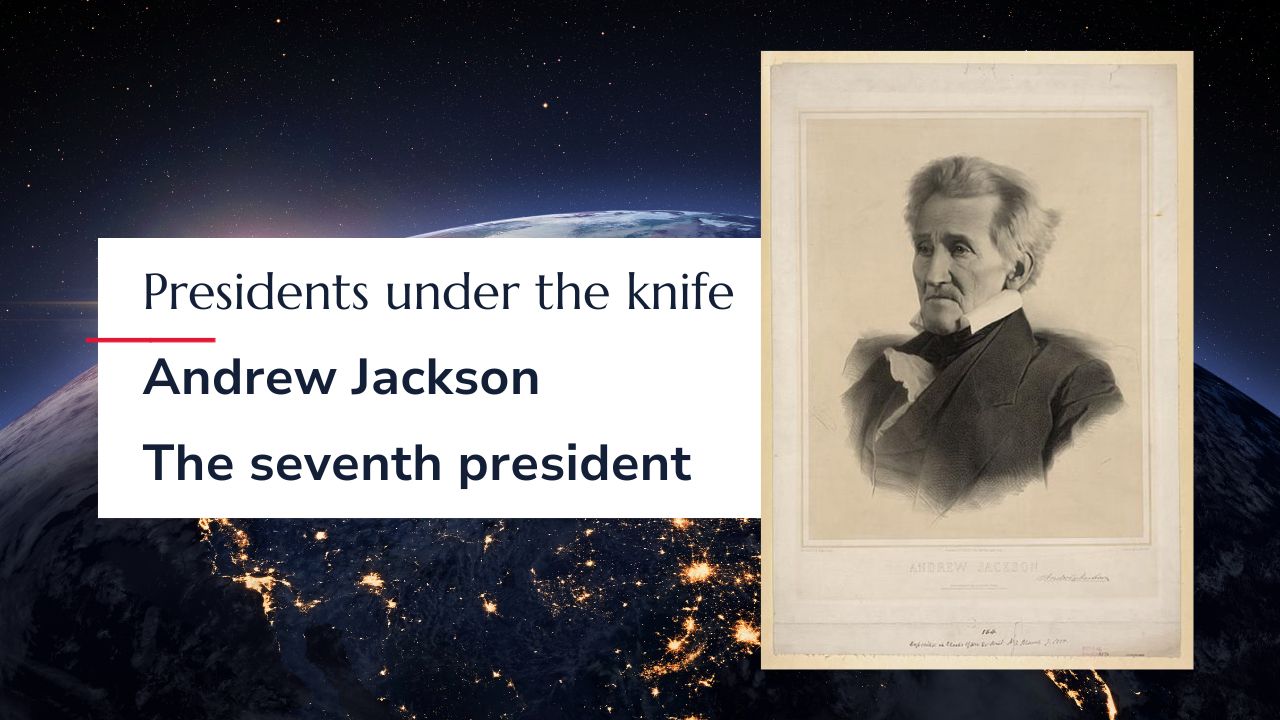
Portrait of Andrew Jackson, 1856. Library of Congress, Prints and Photographs Division, Washington, D.C. In the public domain.
The seventh president: March 4, 1829-March 4,1837
Born in the Waxhaw District of South Carolina in 1767 to a Scottish-Irish family, Jackson grew up “a tall, lean, remarkably agile, freckle-faced boy with bright blue eyes, a shock of tousled hair that was almost red and a temper in keeping.”1 Already as young he was known to have a character that “spelled combat, whatever the odds.” Jackson’s temper ended him up in multiple duels and other fights throughout his life.
During an infamous barroom brawl at the City Hotel of Nashville in 1813, Jackson was shot in his left shoulder. A bullet remained in his left upper arm and would stay there for almost twenty years. The wound became infected and, worse, the nearby bone also became infected. Osteomyelitis remains a serious condition causing fevers, pain, and disability. Even with today’s antibiotics, the condition can be difficult to treat, and not infrequently it turns into a chronic problem.
One common feature of osteomyelitis, in addition to its chronicity, is the recurrent episodes of drainage of pus from the infected bone. Sometimes a necrotic fragment of the bone will break away and migrate to the surface of the skin. In such cases, a piece of bone may be felt under the skin or can even penetrate through the skin and be expulsed. This is what happened to Jackson about a year after the barroom brawl. In the fall of 1814, when being engaged in the War of 1812, a sequestrum worked its way from the infected bone and sloughed through the skin.2 Jackson sent the piece of bone to his wife Rachel “as a souvenir,” (a somewhat macabre gift) adding, “I hope all the loose pieces of bone is [sic] out, and I will no longer be pained with it.”3 Unfortunately, the bullet was not expulsed at the same time; it would remain in Jackson’s arm and continue to cause problems for another eighteen years.
During all those years, Jackson continued to have pain and discomfort from his arm, at times making “the arm almost useless.” The problems would culminate in 1831, two years after Jackson assumed the Presidency of the United States for his first term. The bullet fired at Jackson’s left shoulder had started to migrate and could now be felt under the skin close to the wound in the left upper arm. In April 1831, with the pain intensifying, Jackson considered traveling to Philadelphia to see a surgeon but canceled the trip when he realized the political ramifications caused by seeing the President needing surgery. Instead, he tried to cope with it.
When the pain ultimately became unbearable, he decided to have the bullet removed. This time, the surgeon, Thomas Harris of Philadelphia, was summoned to Washington for the operation. The procedure took place on January 12, 1832. Of course, anesthesia was not available, so Old Hickory “simply bared his arm, gritted his jaws, grasped his walking stick,” and told his surgeon, “go ahead.” Dr. Harris made an incision, squeezed the arm, and “out popped a ‘half ball’ of the ordinary pistol size.” After the wound had been dressed, the President “went right back to work” and was able to attend “a small dinner party that evening.”
__________
This post contains material from Presidents Under the Knife: Surgical Successes, Failures and Deceptions © 2025 Per-Olof Hasselgren by permission of McFarland & Company, Inc., Box 611, Jefferson NC 28640.
References
1.James, Marquis. The Life of Andrew Jackson. Complete in one volume. Part One: The Border Captain; Part Two: Portrait of a President. The Bobbs-Merrill Company, Indianapolis, IN. 1938
2.Rosenberg, J.C. A study of Andrew Jackson’s wounds and illnesses. American Journal of Surgery 117:721-725, 1969
3.Remini, Robert V. The Life of Andrew Jackson. Harper Perennial Political Classics, New York, 2009 – Based on Remini, Robert V. The Life of Andrew Jackson. Vol 1, 1977; Vol 2, 1981; Vol 3, 1984
4More about Jackson’s surgery in Presidents Under the Knife (McFarland Publishing Company, 2025). Available at Amazon.




.png)





.jpg)