
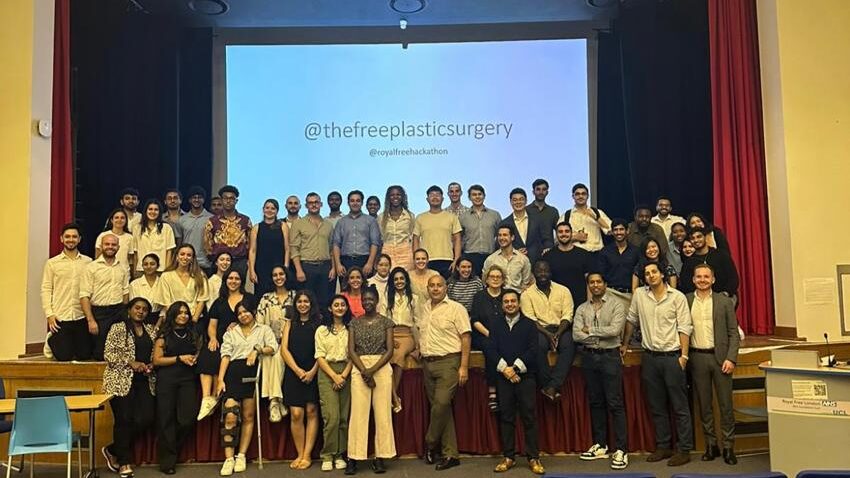
Figure 1: Attendees at the Hackathon.
Sustainable surgery, healthcare efficiency and the use of MedTech and Artificial Intelligence (AI) are three major focus points for healthcare systems worldwide. In the United Kingdom, the National Healthcare Service accounts for a quarter of UK public sector emissions 1. With the UK government targeting net zero by 2050, there is an urgent need for increased sustainability in surgery and healthcare to meet this target 2. Furthermore, healthcare costs are rising; governmental healthcare expenditure grew 9.6% between 2020 and 2021, the fastest year-on-year growth rate since records began in 1997 3. This emphasises the need to improve efficiency to make budgets stretch further. AI in healthcare has the potential to increase efficiency and it has been reported that generative AI will grow faster in health care than any other sector 4. In order to tackle the questions that come with these changes to healthcare systems, innovations and innovators are needed.
A collaborative Hackathon between the Royal Free Plastic Surgery Department, the Association of Surgeons in Training (ASiT) and the Plastic Surgery Trainees Association (PLASTA) was held on the 9-10 th October 2023 at the Royal Free Hospital. This was following the successful Royal Free*PLASTA Hackathon in November 2022. In attendance were 58 talented and entrepreneurial-minded delegates, speakers and mentors from ground-breaking start-ups including CMR Surgical and judges from a range of backgrounds including Professors of Plastic Surgery, Business Professors and the founder of Proximie.
The Royal Free Hackathon had three main aims for delegates to focus their innovations revolving around (i) making surgery more sustainable, (ii) the use of ChatBots to improve healthcare outcomes and (iii) how to improve operating room efficiency.
The two-day Hackathon was kickstarted by a series of teaching lectures on sustainable surgery, how to create a successful innovation pitch, the future of surgery and a talk from the Royal Free Accelerator for Intelligent Surgery and Enterprise (RAISE). The objectives of RAISE are to provide mentorship and funding to talented young people and doctors with strong innovation ideas to help them fulfil their healthcare business ventures. Following the lectures, delegates networked to form eight teams consisting of 3 to 6 members.
The second day consisted of the teams pitching their ideas to the judges who marked them based on the originality of the innovation, the primary research behind it, the scale of the problem and the presentation itself. The winning team’s innovation was a chatbot for remote monitoring of hand therapy patients with personalised exercise regimens and built-in AI to determine their recovery progress to hasten recovery without having to physically see a hand therapist in clinic, thus reducing the healthcare costs and improving outcomes. Other teams’ innovations focused on reducing intra-operative waste, prehabilitation programmes for patients and AI chatbots to streamline communication with GPs. The winning team’s prize included an oral presentation slot at the ASiT Future Surgery Conference 2023 and a monetary prize. Money was also awarded to runners up and commendations were awarded to any teams the judges felt showed promise with their innovations.
Figure 2: The winning Hackathon team HandStrong.
To conclude, the Royal Free*ASiT*PLASTA Hackathon demonstrated how by encouraging collaboration and providing mentorship, young entrepreneurs can help find solutions to current and future healthcare challenges. We aim to repeat and expand the reach of the Royal Free Hackathon to find more talented students and doctors to help increase sustainability, improve efficiency and ultimately improve patient satisfaction and outcomes.
Figure 3: Hackathon organising committee, from left to right Mr Petko Shtarbanov, Dr Alexander Zargaran, Miss Zahra Ahmed, Dr Christian Asher, Dr Matthew Harris, Dr Angela Lam, Dr Nikita Joji.
References
1MacNeill AJ, Lillywhite R, Brown CJ. The impact of surgery on global climate: a carbon footprinting study of operating theatres in three health systems. Lancet Planet Health. 2017;1(9):e381-e8.
2Zero DfESaN. Review of Net Zero. Department for Business E IS; 2023.
3(ONS) OfNS. ONS website, statistical bulletin, Healthcare expenditure, UK Health Accounts: 2021; 17 May 2023.
4Group BC. Medtech’s Generative AI Opportunity. 2023.
.png)





.jpg)

