

BJS-2026-0162
Surgical news
View from the dark side
Guest blog
General
The radiologist who cried wolf
Dr Paul McCoubrie
Southmead Hospital, Bristol
04072026
Welcome back to Dr Paul McCoubrie’s a 'view from the dark side' — a series looking at the world of surgery through the lens of a radiologist.
_______________________
The best kind of radiologist is like a master butler. No, not a subservient minion that exists solely to wait hand and foot on their higher and betters. More a Jeeves character; a loyal, devoted and skilful servant, advising, persuading and supporting but never usurping.
I would never make any assertions that, in this analogy, surgeons are like Berty Wooster. No, that is tantamount to being disrespectful. But I imagine that in a fantasy surgical hospital, radiology reports would be served on a silver salver by white-gloved radiologists who appear noiselessly on a mere surgical finger click. The one time I mentioned this vision to a surgical colleague, they smiled, looked momentarily ecstatic and almost salivated.
Meanwhile, back on Planet Earth, no such deliveries will ever occur. The reality is an increasingly anonymous pile of radiology reports that crowd the desks of surgeons. Well, often an electronic message as hospitals move away from the expense and faff of paper reports.
If a surgeon is lucky, these reports concern patients that are actually under their care. If a surgeon is really lucky, they will have a secretary who will keep a track of radiology and pathology reports for them, marrying these up to the notes of patients under current investigation.
The reality is not so joined up. Personal secretaries are a fading memory for many surgeons and dysfunctional pooled secretaries benefit no one, certainly not the surgeon. Furthermore, the vagaries of hospital IT means that the daily deluge of results may or may not tally with patients that the surgeon has actually seen.
The result? Inbox chaos. All the surgeons I know are drowning in electronic paperwork, more than ever before. 99% underwater with occasional gasps. Many work unpaid in the evenings and weekends just to survive. Others survive by disengaging. They have a permanent out of office response on, practically ignore email, messaging apps and text messages; you can only get a response from ringing their mobile phone. I honestly don’t blame them.
It is paradoxical that electronic communication is intended to make us more efficient and yet has had the opposite effect. The effect is electronic gridlock. An absolute mess where messages from all and sundry rain down on the surgeon in an e-torrent. Surgeons having 1000s of unread emails, messages and voicemails are common: they simply cannot stay on top of this daily tsunami of electronic chaff.
Radiology reports make up a significant chunk of this influx. You might expect that radiologists would be sympathetic to the plight of the modern surgeon. The radiologist might think, “The poor blighters. How about I make the report really concise and easy to read? Perhaps I can add a really clear conclusion so that their is no ambiguity?”. And indeed there are enlightened radiologists out there that do this. I consider myself this way inclined.
However, most radiologists don’t bother. They carry on producing gargantuan reports seemingly only to satisfy themselves. And the conclusion section? Sometimes longer than the body of report and containing more hedges than Hampton Court Maze. Many radiology reports make me want to scream.
But the thing that surgeons tell me that they really hate is the responsibility of not missing an important message. They have to sift through a veritable haystack of messages to find the essential needle, the email or report containing something of importance. Of course, as a consultant, the buck stops with you. Miss the message and there is no defence if something goes wrong and the patient comes to harm.
To assist this seemingly impossible task, many hospitals have a system of alerting referring clinicians to important messages. In radiology, if there is something absolutely crucial, I’ll telephone the surgeon directly. If it is important but not immediately life-threatening, we have a system of alerting the referrer. But we tend to reserve it for unexpected findings. For example, if you ask me to look for a post-op complication and the scan shows a leak, an abscess, a haematoma or what have you, then I’m not picking up the phone or getting our secretary to contact yours. I expect you to look at the result. And this largely works. It is sensible.
Except there has been a subtle shift in the landscape. There have been several medicolegal rulings that state fairly unequivocally that this isn’t good enough. Assuming the surgeon or physician will look at the result of the urgent scan does not stand up in court. The radiologist has to ensure the referrer knows of the scan result via an alerting system.
Radiology alerting systems are generally a good thing. It helps the surgeon sleep at night if they know anything urgent has been flagged up for them. The radiologist knows the referrer has the urgent report. And hopefully the patient benefits too.
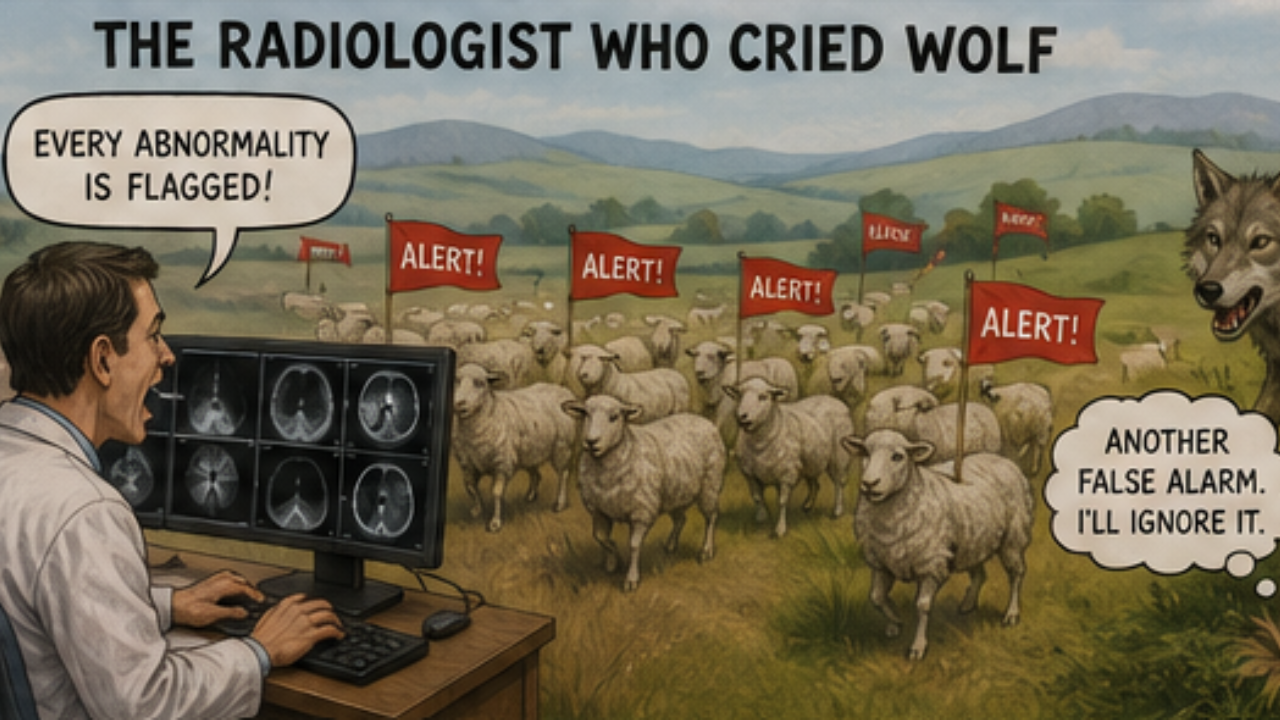
For alerting systems to retain their function, there has to be tight control over what gets flagged up. If you flag up every abnormal scan this means around 30-50% of scans triggers an alert. Which doesn’t help pressured surgeons. If everything is urgent, nothing is urgent. And importantly normal (or near normal) scan reports don’t get read. An unread radiology report is a dangerous report.
The problem is that certain radiologists, certain institutions or external outfits are increasingly risk averse. It is a truism that radiologists get blamed for every clinical error, anything that goes wrong. We are the kicking posts of the hospital as our reports and scans are preserved in beautiful digital detail.
So there is an increasing trend to flag up all abnormalities, even minor or putative ones. It annoys the hell out of my surgical colleagues, who often have little idea of what the radiologist means. So each alert translates into another patient on the multidisciplinary team meeting, another patient is discussed at the x-ray meeting or another email to a friendly local radiologist is generated.
I call this the ‘radiologist who cried wolf’ problem, after the Aesop’s fable of the shepherd boy who falsely cried out that a wolf was attacking his sheep hence was ignored when a wolf really attacked. It’s an increasing problem with a relatively simple answer.
There was a time when a publicly delivered cutting rebuke to the offending radiologist was all that was necessary. Their nonsense soon stops. But you can’t do that to a teleradiologist. You can however, reply to their clinical lead that ‘calling wolf’ is supremely unhelpful for you, for the patient and their care. And please stop. Precisely how then individual surgeon phrases their negative feedback is a personal choice. But I would advocate for a robust and unequivocal response that is largely free of questions about their parentage or the validity of their medical qualifications.




.png)





.jpg)

