
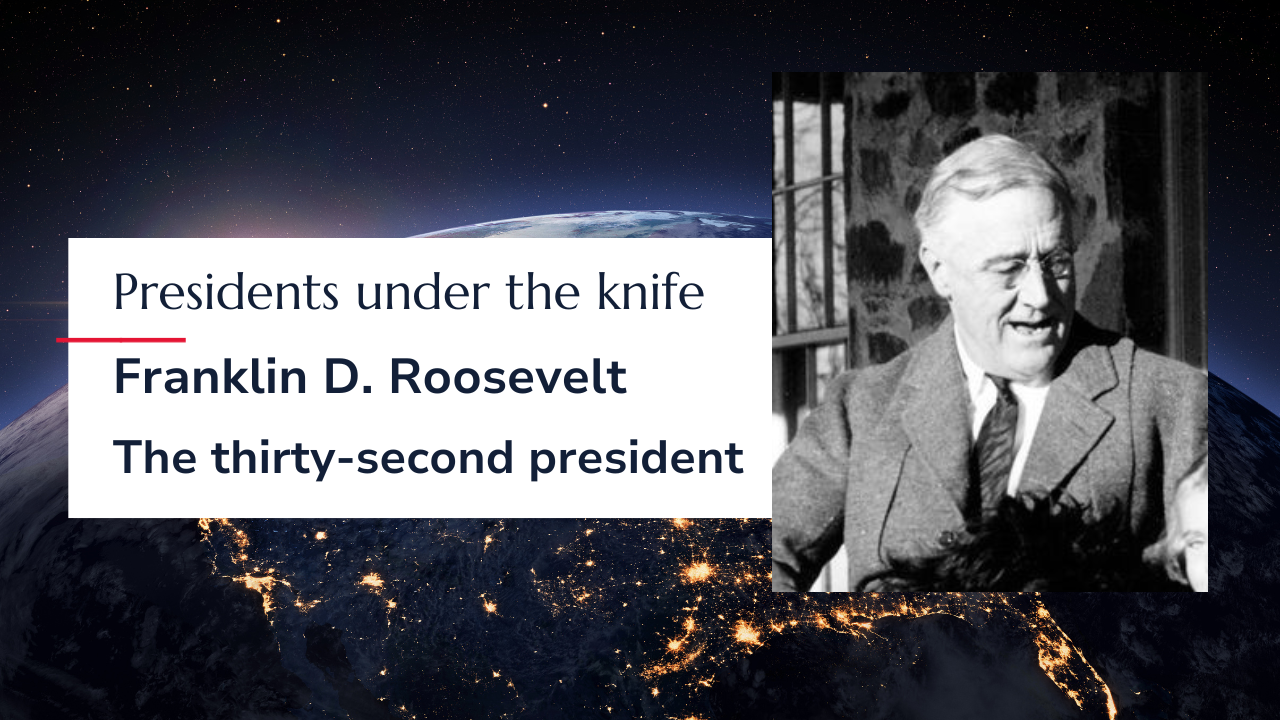
Franklin Delano Roosevelt was the thirty-second president (March 4, 1933 - April 12, 1945). The image shows FDR at Hill Top Cottage in Hyde Park, NY, together with his Scottish terrier Fala and Ruth Bie, the three-year old granddaughter of the cottage caretakers. The photograph was taken by FDR’s friend and distant cousin Margaret “Daisy” Suckley in February 1941. Collection-FDR Photos; Franklin D. Roosevelt Library Photographs. (Public domain)
Roosevelt’s paralytic illness: disability and deceptions
Many of FDR’s health issues were kept secret and still remain a mystery. Astoundingly, a majority of American citizens were unaware of the president’s paralytic illness, being fooled by the secrecy and deception created by Roosevelt and his family and advisers. The press helped him with the scheme and had agreed not to show Roosevelt in what he would consider compromising pictures. His public appearances were arranged to prevent the press from seeing his arrivals and departures and block the public from seeing him getting in or out of a car or train. Privately, Roosevelt used a wheelchair, but only few official pictures exist of Roosevelt in a wheelchair. Even the Secret Service pitched in and occasionally ripped the film out of the cameras of over-zealous journalists showing Roosevelt in a wheelchair or being helped in or out of a vehicle.
So successful were the efforts to hide Roosevelt’s disability from the public that many political figures in Europe remained unaware of his disability for years. A journalist stationed in Europe during the ten years leading up to the Second World War, reported, “I repeatedly met men in important positions of state who had no idea that the President was disabled.”1
Although Roosevelt’s symptoms of fevers and chills, nausea, and back pain on August 10, 1921, were initially diagnosed as a “heavy cold,” after several weeks of worsening weakness of both legs, Roosevelt was diagnosed with poliomyelitis in late August.2 Medical historians have questioned whether a tonsillectomy in 1919 may have contributed to Roosevelt’s infection with the poliovirus. More recently, even the diagnosis has been challenged, questioning whether Roosevelt suffered from Guillain-Barré Syndrome rather than polio.
Minor surgeries while in office
Though Roosevelt was protective about his health situation and worked hard on concealing his disability for the American people, he thought it was okay to disclose a few minor surgical procedures he underwent while in office.
In mid-November 1937, Roosevelt developed sever pain from an abscessed tooth. The misery was accompanied by high fever with the temperature reaching 103˚F. It was obvious the tooth needed to come out.
The day before the procedure, the President was called on in his bedroom by several individuals who needed to discuss pressing political issues. Postmaster General James A. Farley was among the visitors. He later recalled the encounter with the President, "I was shocked by his appearance,” and added, “His jaw was swollen … During the entire interview he kept an ice bag to his jaw to relieve pain.”3
The recovery from the tooth extraction took longer than expected. Some three weeks after the operation, the President was still having pain. At a press conference on December 5, 1937, he told the reporters, “If anybody punched me there I would be sore.” He continued, “Putting it as a layman, I would say that it has not healed.” It did, of course, ultimately heal and Roosevelt would not need another operation until almost seven years later.
A second minor surgical procedure was related to a swelling Roosevelt had noticed on the back of his head for about twenty years. Doctors had diagnosed the swelling as a sebaceous cyst (a “wen” in laymen’s language). It had progressively increased in size over the years and started to become a nuisance when his hat band rubbed against it. Now, he wanted it removed. A surgical procedure was scheduled for February 2, 1944, at Bethesda Naval Hospital.
Most surgeons would consider the excision of a sebaceous cyst a minor procedure, often performed in the office under local anesthesia. But this time it was different; after all, the patient was the President of the United States. No less than seven doctors and two nurses were in attendance in the operating room on that day in February 1944. The patient remained seated in his wheelchair with the head resting against a support constructed especially for the event. The operation was performed under local anesthesia. The lesion was “about the size of a hen’s egg and almost exactly in the midline.” Eight stitches were needed to close the incision.
The scalp is a blood-rich area of the body and bleeding from the operation soiled the President’s undershirt which had to be replaced with a clean one. Despite that, “everything went off beautifully.”4
Words about Roosevelt’s surgery quickly leaked to the news media. The White House Press Secretary Steve Early was awakened several times in the middle of the night by journalists asking if it was true that the President had been undergoing surgery. Early kept repeating that, “The President wants to tell you about it himself.”
At a press conference two days after the surgery, reporters were excited and bombarded the President with questions. They, of course, wanted to know if he had been under the knife. Roosevelt tried to deflect the attention to his operation and move on to more important issues by joking about it. “Sure, I was under the knife. I am under the knife whenever I cut my fingernails.” The journalists caught on to the humor and asked, “Mr. President, did those Naval ‘gims’ permit you to smoke while they did their hacking?” to which Roosevelt replied, “No, but I yelled for a cigarette right afterword.”
The following day, the President’s surgery was mentioned in the newspapers but did not create big headlines. The New York Times had a small headline, one column wide, “Went Under Surgery, Roosevelt Discloses; But It Was Only For An Old Wen On His Head, He Says.” Washington Post used the headline “Roosevelt Recovers From Minor Surgery.” Other newspapers throughout the country also mentioned the operation with small articles.
No further questions regarding the President’s operation were raised by the press and the event was soon forgotten.
Tampa Bay Times, Saturday February 5, 1944.
Uncontrolled hypertension
In January 1944, Roosevelt complained of frequent headaches. He was also fatigued and generally did not feel well. Roosevelt’s secretary, Grace Tully, had noticed “the Boss occasionally nodding over his mail or dozing a moment during dictation.” A review of Roosevelt’s medical records revealed that the president’s blood pressure had been elevated at least since 1940. In March of 1944, it was 180/108 mm Hg. The hypertension would continue to worsen during the remaining year of Roosevelt’s life and cause his death. When he arrived at Warm Springs at the end of March 1945, the blood pressure was 240/130 mm Hg. Although relaxing at the resort seemed to have an initial positive effect, shortly after 1 pm on April 12, Roosevelt had what most likely was a massive cerebral hemorrhage. Immediately after the event, he was examined by his cardiologist, Dr. Howard G. Bruenn. The blood pressure had skyrocketed. The systolic blood pressure was “well over 300 mm Hg; diastolic pressure was 190 mm Hg.” At 3:35, the President was dead.
Did Roosevelt have surgery for melanoma?
Although the evidence was strong that Roosevelt died from a “garden-variety” stroke caused by hypertension, medical historians have recently raised the question whether the president’s death was caused by hemorrhage into a brain metastasis from a malignant melanoma. Multiple photographs from the 1930s revealed a pigmented skin lesion above the president’s left eyebrow. From 1940, the “brown blob” started to grow smaller and show evidence of partial surgical removal. These observations generated speculations that Roosevelt may have had a malignant melanoma above his left eyebrow and that the cause of the president’s death on April 12, 1945 was a bleeding into a brain metastasis from a melanoma.
Roosevelt in August 1938 (age 56 years) with an asymmetric, brown, slightly raised plaque above the left eyebrow. The pigmented skin lesion was larger in August 1938 than in a picture from 1933. A subsequent photograph in 1940 showed changes consistent with partial surgical removal of the lesion.5
Continued mysteries
Although, in this blog, we have looked into some controversies related to Roosevelt’s paralytic illness (was it polio or Guillain-Barré syndrome?), the “brown blob” above his left eye (was it melanoma?), and the way he died, (was it a “garden-variety” of cerebrovascular catastrophe caused by hypertension or was it bleeding into a metastasis from a malignant melanoma?), the last couple of years of Roosevelt’s life were associated with several additional mysteries related to his health and medical care. The secrecy and deceptions would even continue for decades after his death (and have still not been completely resolved).
Of course, the question must be asked: why all the secrecy and deceptions? While it is easy to understand that disclosure of the President’s health problems towards the end of the Second World War would have risked the outcome of the conflict, it may be more difficult to comprehend the rationale for why the secrecy has continued even after Roosevelt’s death.
Historians have given several explanations. One reason for concealing Roosevelt’s health status provided by some writers has been that physicians involved in the medical treatment of the president wanted to protect their own reputations and ward off accusations that their management of the president’s health may have been inept.
Several researchers have also pointed out that full disclosure of Roosevelt’s physical and mental decline towards the end of his life would propagate the narrative about the “sick man at Yalta” and his inadequate (according to some) representation of the interests of the United States during the final meeting between the three allied leaders.
Recently, a medical historian added an additional reason why much of Roosevelt’s medical situation remains a mystery, explaining that, “all of FDR’s medical records disappeared within several days of his death and have never been recovered.”6
____________
This post contains material from Presidents Under the Knife: Surgical Successes, Failures and Deceptions. © 2025 Per-Olof Hasselgren by permission of McFarland & Company, Inc., Box 611, Jefferson, NC 28640
References
1.Gunther, John. Roosevelt in Retrospect. New York: Harper and Brothers, 1950
2.Goldman, Armond, et al. What was the cause of Franklin Delano Roosevelt’s paralytic illness? Journal of Medical Biography, 11:232-240, 2003
3.Farley, James A. Jim Farley’s Story: The Roosevelt Years. New York: Whittlesey House, 1948
4.Lomazov, Steven, and Eric Fettman. FDR’s Deadly Secret. New York: Public Affairs, 2009
5.Ackerman A. Bernard, and Steven Lomazow. An inquiry into the nature of the pigmented lesion above Franklin Delano Roosevelt’s left eyebrow. Archives of Dermatology, 144:529-532,2008
6.Goldsmith, Harry S. Presidential operations. Journal of the American College of Surgeons, 209:546-547,2009




.png)





.jpg)

