
Despite increasing representation in surgical training, women surgeons still face many challenges that undermine the long‑term sustainability of their careers. The well‑documented underrepresentation in senior academic and leadership roles is partly due to structural barriers, including exclusion from informal networks, but also to difficulties in managing work–life balance1.
Maternity profoundly impacts the careers of women surgeons, presenting unique challenges that span from early family planning to returning to the operating room. In Europe, pregnant surgeons generally prefer to continue operating, but their surgical activity typically decreases as pregnancy progresses. Different patterns are observed based on seniority and geography: while senior women doctors tend to end their surgical duties later in pregnancy than junior trainees, European surgeons overall cease operative duties earlier than their North American counterparts, who often continue their surgical activity well into pregnancy. Furthermore, fully paid maternity leave across surveyed European nations varies from as little as 4 weeks up to 32 weeks, with data showing women surgeons taking an average of 10 months of total parental leave2,3.
While only a minority of European countries require a change of duties for pregnant clinicians, Italy makes a strong exception regarding specific occupational hazards. Occupational safety and maternity protection are governed by Legislative Decree No. 151/2001 and No. 81/2008, which mandate the removal of pregnant workers from tasks involving potential biological, chemical, or physical risks. In surgical environments, these laws are frequently interpreted as a total incompatibility with operating room activity, and pregnant surgeons are often excluded from operative practice for nine to twelve months or longer2.
The unique reality of Italian law, although designed to ensure workplace safety, has serious consequences on women surgeons’ training progression, procedural autonomy, and academic competitiveness. When evaluation systems for hospital or academic roles (concorsi) fail to take the pregnancy variable into account, formally neutral criteria—such as raw operative volume or absolute publication counts—unintentionally generate indirect discrimination against those who have taken legally mandated leave4,5. This regulatory framework may also place Italian surgeons at a structural disadvantage compared with colleagues working in international environments governed by more flexible, risk‑mitigation–based models.
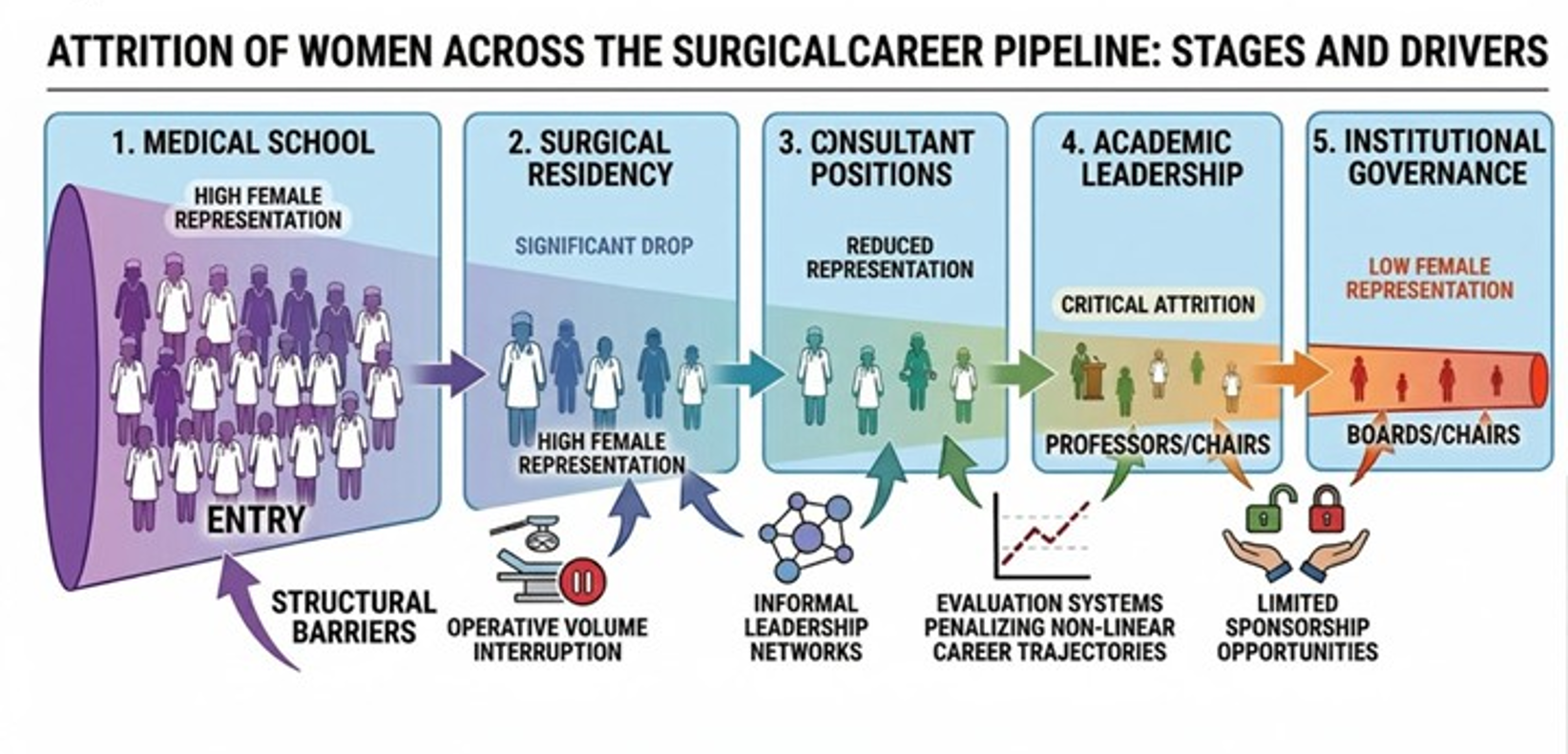
Figure 1A
Attrition of women across the surgical career pipeline.
Conceptual representation of the progressive reduction in female representation across successive stages of surgical careers—from medical school and residency to consultant positions, academic leadership, and institutional governance. Structural barriers, including operative volume interruption, informal leadership networks, evaluation systems that penalize non-linear career trajectories, and limited sponsorship opportunities, contribute to this attrition. Institutional reforms aimed at transparency, mentorship, and equitable evaluation may mitigate these effects and improve long-term career sustainability.
This adds to a system where women surgeons already face higher thresholds for credibility and limited inclusion in informal professional networks. Leadership pathways often remain relational rather than purely meritocratic, reflecting systems where gender diversity was not historically embedded in governance models (Figure 1)4. Besides the obvious loss represented by the lack of a truly meritocratic system, this also results in a significant waste of resources, given the impact of surgical training and the years required to form a fully independent surgeon.
Figure 1B
Structural determinants of sustainability in surgical careers.
Conceptual framework illustrating the transition from individual resilience to institutional responsibility in supporting sustainable surgical careers. Structural barriers—including operative volume interruption, informal leadership networks, and evaluation systems that penalize non-linear trajectories—create attrition pressure along the surgical career pathway. Institutional reforms addressing these determinants enable retention, equitable advancement, and inclusive leadership.
To transition from individual resilience to institutional responsibility, the following framework for reform is proposed:
Transparent leadership selection: predefined weighted criteria and mandatory external members in selection commissions to ensure meritocratic and unbiased appointments.
Structured post‑maternity reintegration: formal re‑entry programs, including institution‑funded advanced simulation and dedicated tutoring for 6–12 months post‑return.
Proportional merit assessment: evaluating productivity per active working year, effectively neutralizing the impact of mandated exclusion periods.
Formalized mentorship and sponsorship: structured programs, such as the Mentor WIS initiative, to provide authoritative points of reference and active sponsorship for board roles within scientific societies5.
The future of surgery will not be determined by how many women enter the field, but by how many are enabled to remain, progress, and lead. Remaining in surgery must not depend on exceptional individual resilience; it should be the natural consequence of institutions capable of recognizing talent, protecting merit, and embracing inclusive leadership.
References
1.Parini S, Lucidi D, Azzolina D, Verdi D, Frigerio I, Gumbs AA, Spolverato G. Women in Surgery Italia: National Survey Assessing Gender-Related Challenges. J Am Coll Surg. 2021;233:583‑592.e2.
2.Biju S, Madden C, O’Connor P, et al. Fertility, family planning, pregnancy and motherhood among women doctors working in the EU and UK: a scoping review. BMJ Open. 2025;15:e105560.
3.Juliebø‑Jones P, Pietropaolo A, Spinoit AF, et al. Rules and regulations for a pregnant endourologist: the European perspective. World J Urol. 2022;40:857‑864.
4.Ferrari L, Mari V, De Santi G, et al. Early Barriers to Career Progression of Women in Surgery and Solutions to Improve Them: A Systematic Scoping Review. Ann Surg. 2022;276:246‑255.
5.Pierobon ES, Capelli G, Frigerio I, Spolverato G. Mentor WIS: an Italian mentorship programme for female surgeons. BJS. 2023;110:983‑984.

.png)





.jpg)

