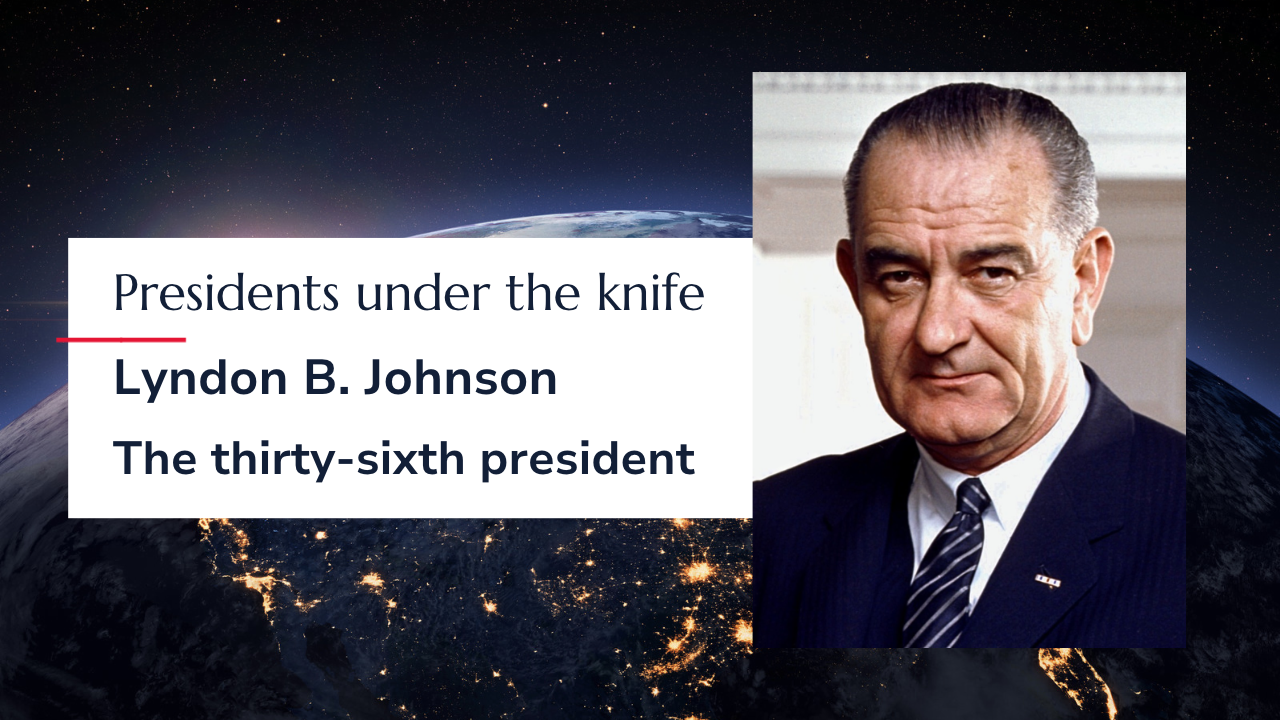
Lyndon B. Johnson. Alamy Stock Photo. Credit: Pictorial Press Ltd.
The thirty-sixth president: November 22, 1963 – January 20, 1969
Lyndon B. Johnson did not have the easiest childhood. He was born in Stonewall, Texas, on August 27, 1908, into a family that had its share of conflicts and struggles. He was number one of five children who saw the family harmony frequently destroyed by their father’s drinking habits. Lyndon’s mother was ”strong-willed” and made certain her son learned history and geography from an early age and pushed him to “achieve unusual things in his life.”1
Lyndon took up smoking during his college years and soon became a heavy smoker, initially smoking the pipe (which was the cool thing to do in those days), later cigarettes, up to the point when he was a chain-smoker. His biographer Robert Caro commented, “he seemed … always to be holding a cigarette and his fingers were stained yellow with nicotine.”2 LBJ was known for being a workaholic, never allowing a break but always “pushing himself and everyone else mercilessly.” Johnson’s brother at one point commented that Lyndon continued “to drive himself at a furious pace.”3
Being a workaholic and a chain-smoker, in addition to having a strong family history with “all of the men in the Johnson family” having died early of heart disease,4 put LBJ at high risk for cardiovascular disease. Johnson had several heart attacks during his lifetime. The first struck him at the age of 47 in 1955 and the last killed him eighteen years later.
Running for Congress and having an appendix “on the point of rupture”
In 1937, Johnson was in “his first desperate campaign as an unknown candidate for Congress.” Several days before the election, Johnson started to suffer increasing abdominal pain, nausea and vomiting, but refused to cancel or postpone his campaign. On April 8, two days before the election, the pain was reaching a climax, but he decided to keep going and gave a speech at a rally in the Travis County Courthouse in Austin, Texas. At this time the candidate was really feeling sick. His pain was nearly unbearable. He was sweating, and had to hold on to the railing of the lectern while giving his address. In the midst of the discourse, Johnson doubled over from pain and had to sit down. After a short while, he got back up again and finished his speech. At the end of the rally, Johnson shook hands with the listeners, but then finally gave up and allowed himself to be taken to the hospital. He underwent emergency surgery and had his appendix removed. His surgeon explained that Johnson’s appendix had been “on the point of rupturing.”2, 4
Johnson’s gallbladder surgery
In early September 1965, when on a visit to his ranch in Texas, Johnson developed pain in the right upper portion of his abdomen. He was diagnosed with acute cholecystitis. The president’s symptoms subsided and he was able to fly back to Washington. An oral cholecystography revealed that the gallbladder was not functioning properly, supporting the diagnosis of cholecystitis. As an incidental finding, the x-ray also showed a kidney stone that was stuck in the middle portion of the right ureter. The president was recommended to undergo a cholecystectomy and at the same time removal of the kidney stone.
When the president was brought to the operating room in the morning of Friday October 8, the surgical theater was crowded; in addition to the principal surgical team, led by Dr. George A. Hallenbeck, a world-renowned surgeon from the Mayo Clinic, the room was filled with seven additional doctors, a number of nurses, and three Secret Service men. After general anesthesia had been induced, a “generous, right subcostal incision was made.”5 After the abdomen had been opened, the surgeons found that the gallbladder had a “substantial amount of associated acute inflammation.” After the gallbladder had been removed, the kidney stone in the right ureter was taken out by Dr. Ormond Culp, a well-known urologist from the Mayo Clinic, using the same abdominal incision that was made for the cholecystectomy. The operation went well and lasted about two hours.
The President bounced back quickly after the surgery. He was described as “a good patient who complained very little.”5 He was able to take up governmental duties one day after the procedure and could meet with the press on Monday, reassuring the country that he was doing well. The stock market did not tank – everyone was happy.
Johnson was released from the hospital on postoperative day 17. Before that, he had managed to create additional headlines, one of which made a splash not only in America but quickly spread throughout the world as well – today, one would say it went viral. On the twelfth day after the operation, the president wanted to go outside the hospital walls to enjoy a beautiful and sunny day in Bethesda. It would also be a good day for taking pictures. For that purpose, Johnson was positioned at one of the putting greens of the golf course located on the grounds of the Naval Hospital. True to their habits, journalists were shouting questions. When one of the reporters asked how his scar was healing, the president pulled up his shirt, pointed at the scar, and jokingly commented, “this is where the surgeons mucked around.” Cameras were clicking, and a photo shot by Charles Tasnadi of the Associated Press became famous and traveled around the world.
President Johnson pulling up his shirt and showing the scar after his gallbladder surgery performed twelve days earlier on October 8, 1965. Photo: Charles Tasnadi, Associated Press
Johnson’s behavior was probably not as spontaneous as previously thought but was rather calculated. Rumors were spreading after the operation that the president had undergone cancer surgery rather than gallbladder surgery. When Johnson heard about the gossip, he immediately called Dr. Hallenbeck and asked if the incision he had used was typical for removal of the gallbladder. When the surgeon explained that surgery for cancer would have been performed through a midline abdominal incision, Johnson decided to show his scar to the reporters to quell any suspicion that anything else than a cholecystectomy had been performed. After the event, the president happily commented, “That’s one rumor taken care of.”6
Regardless of Johnson’s motive to show off his scar, the image of the President of the United States exposing his belly was mocked by many. Some complained that the behavior was not “presidential” and made Johnson look like “a hayseed with a lack of social graces.”6 His political enemies relished seeing cartoons depicting Johnson with a Pinocchio nose and the scar looking like a map of Vietnam. This was, after all, during the time of the Vietnam War with strong and sometimes violent protests against the conflict in Asia.
Cartoon of President Johnson showing the scar after his gallbladder surgery. Created by David Levine and published in the New York Review of Books (1966) and held in the collections of the Billy Ireland Library & Museum at Ohio State University.
Retirement in Texas
When LBJ decided not to run for re-election in 1968, he was a tired and aging man. He had come to understand that winning a re-election campaign was unlikely considering the situation in Vietnam. During his retirement years at his Texas ranch, Johnson was suffering occasional bouts of depression. He was also plagued by frequent chest pains and shortness of breath. Many noted that he was “perceptively aged and worn.”4
In April 1972, Johnson had another episode of severe chest pain caused by a massive heart attack. Although he survived, Johnson continued to suffer incapacitating chest pains and was in frequent need of oxygen – but he would not stop chain-smoking and eating “an abundance of unhealthful food.”
During the remaining months of his life, LBJ continued to suffer severe chest pain on a daily basis. In desperation, he saw the famous heart surgeon, Dr. Michael DeBakey, and asked if anything could be done. DeBakey, however, understood the risks would be too high and declined to operate on Johnson.
Friends understood the end was approaching, and the former president understood it as well. At one time he uttered, “I’ve got an instinct.”7 Johnson died on January 22, 1973, sixty-four years old. Not surprisingly, the autopsy the next morning found that the death was caused by severe coronary occlusions.
____________________
This post contains material from Presidents Under the Knife: Surgical Successes, Failures and Deceptions. © 2025 Per-Olof Hasselgren by permission of McFarland & Company, Inc., Box 611, Jefferson, NC 28640
References
1.Gilbert, Robert E. The Mortal Presidency. Illness and Anguish in the White House. New York: Fordham University Press, 1998
2.Caro, Robert A. The Years of Lyndon Johnson: Means of Ascent. New York: Alfred A. Knopf, 1990
3.Johnson, Sam Houston. My Brother Lyndon. New York: Cowles Book Co., 1969
4. Bumgarner, John R. The Health of the Presidents. Jefferson, North Carolina: McFarland & Company, 1993
5.Pappas, Theodore N. and Mulvihill, Michael S. The president’s gallbladder: A historical account of the cholecystectomy of Lyndon Baines Johnson. Surgery 2010;147:160-166
6.Lomazow, Steven. The truth about Lyndon Johnson’s Gall Bladder Scar. https://fdrsdeadlysecret.blogspot.com/2011/03/truth-about-lyndon-johnsons-gall.html Posted by Steven Lomazow March 29, 2011
7.Kearns Goodwin, Doris. Lyndon Johnson and the American Dream. New York: St. Martin’s Griffin, 1991