
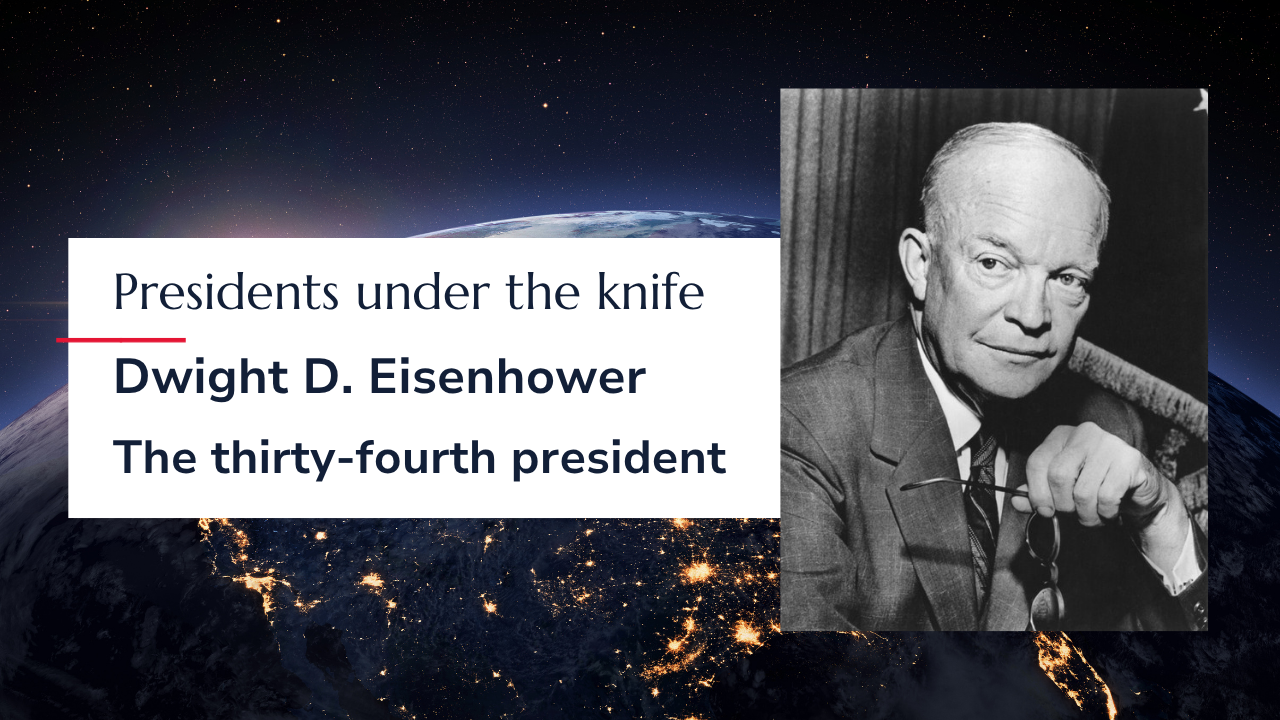
Library of Congress, Prints and Photographs Division, Washington, D.C.
The thirty-fourth president: January 20, 1953 – January 20, 1961
Already when running for his first term as president, a poll found Dwight D. Eisenhower to be the most admired living American, a military leader and war hero who had played a key role securing the victory of the Allied Forces in World War II. Buttons with “I LIKE IKE” were seen everywhere during the presidential campaign 1952 and the slogan was a first significant TV commercial before an election. Not surprisingly, Eisenhower turned out to be a popular president.
Eisenhower had several encounters with surgeons throughout his life. As a young man, he underwent an appendectomy and would later in life undergo three additional abdominal surgeries, one of them while in office.
President Eisenhower’s operation for bowel obstruction caused by “regional enteritis”
Eisenhower had been diagnosed multiple times over several decades with partial small bowel obstruction, the cause suspected to be intra-abdominal adhesions that had formed after his appendectomy in 1923. The episodes had resolved spontaneously up until 1956 when surgery would be needed.
Investigations of the recurrent bouts of bowel obstruction had been performed in May of 1956, and the results suggested that there may be an additional reason, other than adhesions, for the problem. An X-ray with a “small bowel series” revealed a narrow area in the distal ileum, interpreted as regional enteritis or Crohn’s disease, a pathological condition described in the literature only about twenty-five years earlier.1
On June 8, 1956, Eisenhower again experienced abdominal pain. It soon became clear that the president had another episode of small bowel obstruction. His abdomen became distended like that of a “dying frog.”2 This time the symptoms did not resolve and after much deliberation, Eisenhower was taken to the operating room for exploration. The surgeons making the decision to operate were anxious, realizing they were dealing with a 65-year-old high-risk patient who had suffered a serious heart attack only nine months earlier and who was on anticoagulant therapy. Additionally, the patient was the President of the United States in the midst of a campaign for re-election.
Eisenhower underwent an exploratory laparotomy early in the morning of June 9. The doctors, several high-profile surgeons from Washington, D.C. and Philadelphia, found the cause of the bowel obstruction to be a narrow area of the distal ileum, as predicted by earlier X-rays. Although resection of the obstructing area was contemplated, the surgeons decided to perform an ileo-transverse colostomy, thus by-passing the narrow area of the bowel.
The president did well after the surgery. He was out of bed on the first postoperative day and was allowed to resume regular food intake a week after surgery. The president started to conduct official business on the fifth postoperative day. He received official visitors in his hospital room, including Secretary of State John Foster Dulles and Chancellor Konrad Adenauer of West Germany. Eisenhower did not have any complications from the surgery other than a minor wound infection eleven days after the procedure. He was discharged from the hospital twenty-one day after the operation.
Words about Eisenhower’s illness made headlines the same day he was brought to the hospital. Front page banners were screaming, “IKE ILL, TO UNDERGO MAJOR SURGERY,” followed by “Friend And Foe Hope For Quick Recovery.”
Source: The front page of the Daily Press, morning of Saturday, June 9, 1956
The press also became flooded with analyses of the political and economic implications of Eisenhower’s illness. The news of Eisenhower’s surgery resulted in a “nervous fall” on Wall Street. The main political question in June of 1956 was whether Eisenhower’s illness would influence the upcoming presidential election in November. Some journalists speculated that “the Democratic chances for capturing the presidency in the November have been given a big boost by Mr. Eisenhower’s unfortunate illness.”
Source: Editorial, page 4, the Daily Press, Saturday, June 9, 1956
Was it Crohn’s disease?
Although most previous reports in the medical literature reported that the cause of Eisenhower’s bowel obstruction in 1956 was Crohn’s disease, the diagnosis has been questioned by some. Instead it has been proposed that it may have been a post-ischemic stricture, secondary to a drop in blood pressure when the president had a myocardial infarction in 1955.3
Even though it may be argued that the discussion about the underlying cause of the obstruction is merely an academic exercise, the distinction between an inflammatory and ischemic lesion causing the obstruction and necessitating an emergency operation in a patient as prominent as the American President adds an important footnote to history and may be worth contemplating.
The American College of Surgeons and the President’s operation in 1956
All surgeons taking care of Eisenhower in 1956 were Fellows of the American College of Surgeons (ACS). After the surgery, Eisenhower, in a telegram dated October 5, 1956, gratefully acknowledged the ACS for the assistance its surgeons provided during his illness.4 The ACS reciprocated the President’s kind words by appointing him an Honorary Fellow of the organization at a White House ceremony in February 1958.
President Eisenhower receiving his Honorary ACS Fellowship in the White House with his medical team, February 6, 1958. From left: Dr. Howard Snyder; Dr. Brian Blades; Dr. Leonard Heaton; Dr. John Lyons; President Eisenhower; Dr. Isidor Ravdin; Dr. Frank Barry; and National Security Advisor Robert Cutler. Source: University Archives, University of Pennsylvania, Ravdin Papers, Box 14, Folder 4
Surgeries after leaving the White House
In 1966, five years after his presidency, Eisenhower underwent an uncomplicated cholecystectomy. His final surgery took place three years later. The ex-president again developed a small bowel obstruction, this time caused by adhesions. After initial unsuccessful attempts of conservative management, Eisenhower underwent a laparotomy during which the intestinal obstruction was relieved by dividing adhesions. The first couple of weeks after the surgery Eisenhower was doing relatively well, but then his cardiac status began to deteriorate. Despite the efforts of his cardiologists, President Eisenhower passed away on March 28, 1969.
____________
This post contains material from Presidents Under the Knife: Surgical Successes, Failures and Deceptions. © 2025 Per-Olof Hasselgren by permission of McFarland & Company, Inc., Box 611, Jefferson, NC 28640
References
1.Crohn, Burrill B., et al. Regional ileitis: A pathological and clinical entity. Journal of the American Medical Association 1932;99:1323-1329.
2.D’Este, Carlo. Eisenhower: A Soldier’s Life. New York: Henry Holt, 2002.
3.Marston, Adrian. Did President Eisenhower have Crohn’s disease? Journal of Medical Biography 2002;10:237-239.
4.Telegram to the American College of Surgeons from President Eisenhower, October 5, 1956. Ravdin Papers 1912-1972, Box 12, Folder 6, University of Pennsylvania Archives and Records Center.



.png)





.jpg)

