
The EAGLE platform
Anastomotic leak (AL) is the leading cause of major morbidity after bowel surgery. It affects 5-10% of patients, is associated with a 5-fold increase in mortality. and accounts for up to one-third of postoperative deaths. Critically, these are potentially preventable through improved case selection, better intra-operative decision making and good surgical technique. These three key components are individually addressed in the EAGLE education platform (LINK). This platform is now freely available.
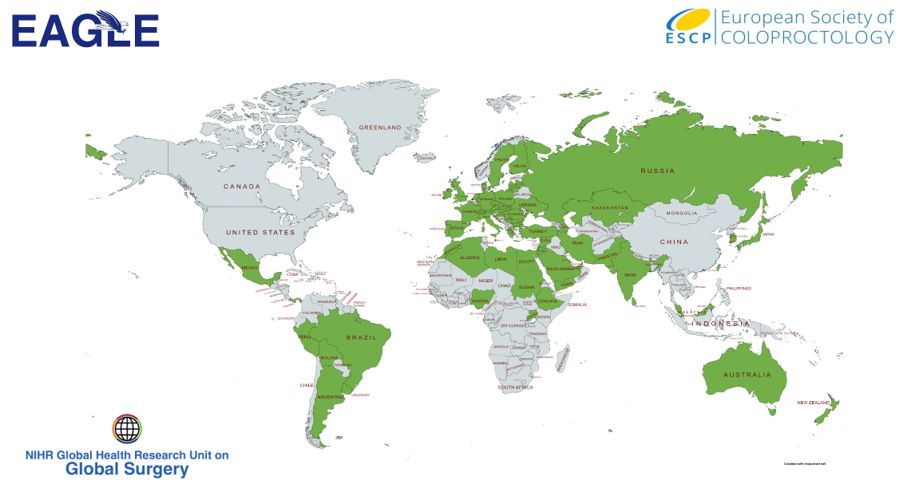
The platform was first tested in the cluster randomised controlled trial – EAGLE, first published in the BJS in 2024 (LINK). This trial involved 332 hospitals in 64 countries and over 2000 surgical team members undertook the training within this controlled setting.
The study demonstrated, in a pre-planned per-protocol analysis that when more than 60% of surgical team members in a given hospital undertook the training, the anastomotic leak rate fell by over 58% (12.2% to 5.1%). This reduction was demonstrated in high-, middle- and low-income countries and even within the same surgical teams in a before/after training analysis.
The surgeons wanted to further test the safe anastomosis platform, to investigate whether these findings might be sustained, and whether the findings might be reproduced outside of a controlled trial, in a real-world setting. The results of the EAGLE-2 study were published in the BJS, September 2026 (LINK).
EAGLE-2 was an international prospective cohort study. Consecutive adult patients undergoing right hemicolectomy from 332 participating hospitals in 60 countries, undergoing right colectomy with primary anastomosis, were included. The EAGLE-safe-anastomosis training platform was made open access, and surgeons were categorised according to whether they had completed the modules before surgery. The primary outcome was 30-day AL.
A total of 2,875 patients were recruited. Of these, 2,242 (78.0%) operations were performed by surgeons who had completed the safe-anastomosis training, while 633 (22.0%) were performed by those who had not. Overall, AL/collection was 16.4% in the non-trained group and 9.1% in the trained group (absolute reduction 7.4%, p<0.001). The adjusted analysis found that training was associated with halved odds of AL (aOR 0.56, 95% CI 0.41–0.78). Training was also associated with reduced reoperation (aOR 0.64, CI 0.45-0.93) and readmission (aOR 0.65, CI 0.43-0.97).
35% of surgeons in EAGLE-2 had undertaken their training 2 years previously as participants in the original EAGLE trial suggesting that benefits of the training could be sustained over time and outside of a trial setting.
We would like to commend the many thousands of surgical team members that undertook this study across the world. Their work has demonstrated that completion of a brief digital training programme was associated with a clinically significant reduction in AL following right colectomy. Training was also associated with lower rates of reoperation, readmission, and death.
This study was run the ESCP and supported by the NIHR Global Surgery Unit. In partnership with BJS, we would now like to widen the uptake of the training. The education platform is freely available here: https://www.escp.eu.com/eagle/home. Scalable digital education can be embedded into colorectal quality improvement programmes worldwide. Surgeons across the world can work together for the benefit of their patients.
.png)

.jpg)

